Tech Empowers Mountain Agriculture Upgrade in Guizhou’s Luodian with Pitaya Industry Expansion
Mountainous regions rely heavily on unique climatic conditions for agricultural development, while technological innovation stands as the core driver of rural industrial upgrading. Leveraging local natural endowments and empowering development with modern technology has become a viable path for mountainous areas to unlock resource potential and realise industrial breakthroughs.
Boasting distinctive three-dimensional climate and solid ecological foundations, mountainous areas in Guizhou have long been constrained by geographical barriers and inconvenient transportation. Favoured natural resources have failed to generate stable income growth for local communities in the absence of systematic industrial planning and technical support. Advancing modern mountain-featured agriculture has become an essential step for local rural economic development.
Luodian County, located along the Hongshui River, has built a distinctive development model centred on pitaya cultivation, opening up a new pathway for rural revitalisation in mountainous terrain. Local industrial practice proves that high-quality mountain agricultural development depends on refined cultivation and innovative technical application. Natural climatic advantages only serve as fundamental conditions for crop growth, and targeted technological breakthroughs determine the conversion efficiency of ecological resources into industrial benefits.
Luodian features abundant accumulated temperature and sufficient sunlight in river valley zones, creating ideal natural conditions for pitaya planting. Early local pitaya development faced prominent bottlenecks including the lack of locally adapted varieties, insufficient anti-freezing management technologies and unscientific cultivation modes, hindering large-scale and standardised industrial expansion. Targeting restrictive factors such as freezing damage, thin soil layers and variety incompatibility, professional research teams have developed improved local pitaya varieties and formulated complete standardised planting systems.
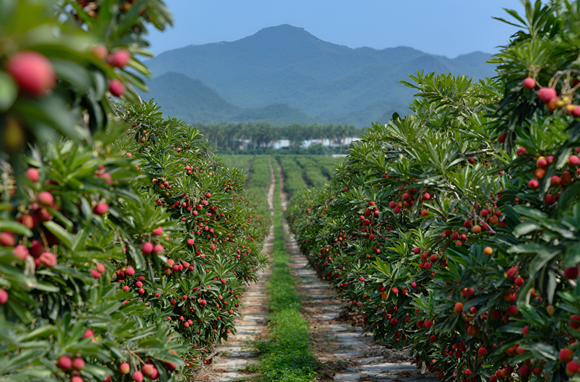
Standardised cultivation techniques have transformed local land utilisation conditions. Wasteland affected by rocky desertification has been renovated into ecological orchards, with vast stretches of pitaya plantations covering mountain slopes. Modern technological applications have reshaped traditional mountain planting models, enabling high-quality fruit production on rocky mountain land and steadily translating ecological advantages into sustainable economic gains for local residents.
Luodian has further expanded industrial value through whole-industry-chain upgrading and digital empowerment. The local pitaya industry has broken the single planting-oriented development mode, adopting digital technologies to optimise every production and sales link. The launch of the Luodian Pitaya Industry Index has realised data-driven industrial governance. Standardised sorting systems and cold chain logistics facilities effectively offset transportation disadvantages caused by mountain terrain, while live-streaming e-commerce channels connect local produce with national consumer markets.
Deep-processing sectors producing dried pitaya fruits and pitaya liquor effectively hedge market fluctuations of fresh fruit sales, forming a diversified and risk-resistant industrial structure. The thriving pitaya industry also delivers comprehensive ecological and social benefits. Pitaya vines conserve soil and water, assisting local rocky desertification management and achieving coordinated ecological restoration and economic development. Industrial profits continuously support rural infrastructure upgrading, improving overall rural living environments.
Guizhou’s mountain agricultural development will continue to focus on exploring regional natural advantages, consolidating technological support and seizing digital and ecological development opportunities. Continuous optimisation of characteristic agricultural layouts will unlock the full value of mountain land resources, enabling high-quality mountain specialties to reach broader markets and sustain the integrated development of ecological protection, industrial growth and rural prosperity.
热门内容推荐