China’s Green Shipbuilding Sector Booms on Global Order Surge and Industrial Upgrading
According to Nanjing Customs data released on July 27, Jiangsu province recorded ship export shipments worth 71.86 billion yuan in the first half of 2026, representing a year-on-year increase of 12.5 percent. Low-carbon and clean energy-powered vessels have emerged as the fastest-growing segment of the regional maritime manufacturing industry, driving accelerated high-end, intelligent and green transformation of China’s shipbuilding sector.
The robust performance of Jiangsu’s shipbuilding industry mirrors the nationwide expansion of China’s maritime manufacturing capabilities. Latest figures from the Ministry of Industry and Information Technology show China’s core shipbuilding indicators have registered comprehensive growth in the first half of 2026, with new order market share exceeding 80 percent globally. Strong uptake of eco-friendly vessel orders has further consolidated the country’s leading competitive position in the international shipbuilding market.
Official industrial statistics underline unprecedented market momentum across the sector. China completed 36.5 million deadweight tonnes of ship construction in the first six months of 2026, rising 51.2 percent year on year. Outstanding ship orders stood at 363.25 million deadweight tonnes, up 54.9 percent from the previous year. Newly secured orders reached 121.06 million deadweight tonnes, a year-on-year surge of 173.1 percent that surpasses the highest annual order volume on record. Listed shipbuilding enterprises in the A-share market have delivered substantial profit growth for the first half of the year, reflecting broad-based industrial prosperity.
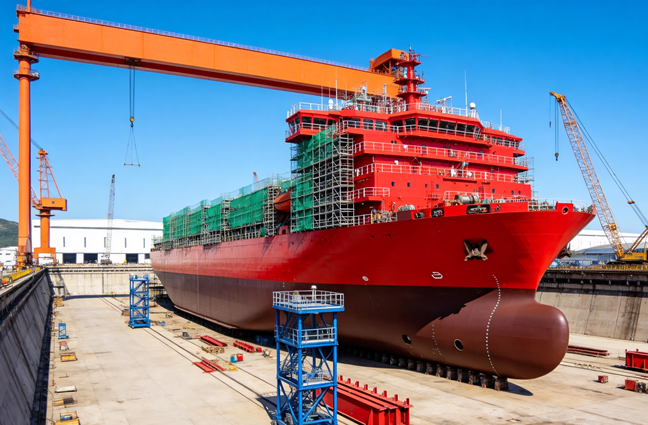
Listed manufacturers have released impressive interim earnings forecasts amid the global shipping upswing. On July 7, Songfa Co., Ltd. projected a net profit of approximately 3.6 billion yuan for the first half of 2026, marking a year-on-year increase of 456.33 percent, with core profit jumping 2,922.83 percent. The company attributes the stellar performance to sustained global shipping market buoyancy, tightened environmental regulations and large-scale replacement of ageing vessels. Expanded order volume, diversified ship types and a rising proportion of high-value oil tankers and container vessels have continuously improved operational profitability.
On July 14, China State Shipbuilding Corporation estimated its first-half net profit would range between 9.2 billion yuan and 11 billion yuan, representing a year-on-year growth rate of 212.29 percent to 273.39 percent. Sufficient order backlogs and optimised order structures have underpinned improved financial results, with increased deliveries of mid-to-high-end civilian vessels and higher average unit ship prices driving overall revenue growth. Major shipyards currently hold order books extending to around 2030, locking in stable operational performance for years ahead.
Multiple catalysts are driving the prolonged industry upcycle. Concentrated replacement demand for ageing fleets, strengthened International Maritime Organization low-emission regulations and extended maritime transportation distances have collectively boosted global shipping capacity requirements. With limited capacity expansion among traditional shipbuilding nations, China’s fully integrated industrial chain has enabled the country to capture the majority of global newbuilding orders, ushering in a phase of high-quality industrial expansion.
China continues to dominate the global green shipbuilding market. The country secured more than 68 percent of the world’s new low-carbon vessel orders in the first half of 2026, maintaining its long-standing global lead in eco-friendly maritime manufacturing. Comprehensive industrial advantages support China’s ongoing technological and market breakthroughs in green ship development.
China’s complete shipbuilding industrial ecosystem and extensive inland waterway networks provide abundant application scenarios for iterative upgrades of electric and methanol-powered vessel technologies. Strong domestic production capacity and cost advantages in power batteries, methanol and synthetic ammonia industries further underpin industrial competitiveness. Continuous technological breakthroughs in high-end power systems and intelligent control solutions have lifted the localization rate of core ship supporting equipment, supporting structural upgrading across the industry.
Maturing port and shipping infrastructure complements technological advancements to accelerate green shipping transformation. Major hub ports have realised regular new energy fuel bunkering services, while shore power coverage at key berths exceeds 90 percent. Popularisation of green port logistics vehicles has facilitated integrated low-carbon operations across ports and shipping routes. Innovative maritime technologies including ship carbon capture, wind-assisted propulsion and methanol and ammonia-fuelled vessel systems have achieved commercial application, driving full-chain innovation in green maritime transportation.
Green shipbuilding will maintain robust growth momentum amid tightening global carbon constraints. Phased retirement of traditional vessels and rapid expansion of dual-fuel new ship orders will sustain industrial expansion alongside improved supporting bunkering infrastructure. LNG-powered vessels will serve as a mature short-term transitional solution, while methanol-fuelled ship designs gain growing market traction for their flexible storage, low retrofitting thresholds and long-term emission compliance strengths. Rising orders for methanol-powered container vessels will further reshape the global low-carbon shipping landscape.
热门内容推荐