China unveils 15th Five-Year renewable energy roadmap advancing power and non-power dual development
According to official information released by China’s National Energy Administration on 23 July, China’s National Development and Reform Commission and the National Energy Administration have jointly issued the official Renewable Energy Development Plan for the 15th Five-Year Plan period. The document balances national energy security and low-carbon transition, clarifying a coordinated development model for power generation and non-power utilisation of renewable energy, and sets clear industrial development routes for the 2026–2030 period.
The new plan drives comprehensive investment expansion across upstream and downstream renewable energy industries, with non-power sectors such as green hydrogen, ammonia and methanol emerging as core growth drivers for industrial expansion. The next five years will mark a new phase of scaled expansion, quality upgrading and reliable fossil fuel substitution for China’s renewable energy sector.
The policy framework incorporates effective capacity indicators including reliable peak-shaving capacity and firm power output into formal development targets for the first time. These updated metrics guide wind and solar power installations to evolve from the primary source of newly installed capacity and incremental electricity generation into the backbone of China’s overall power stock and existing power supply volume.
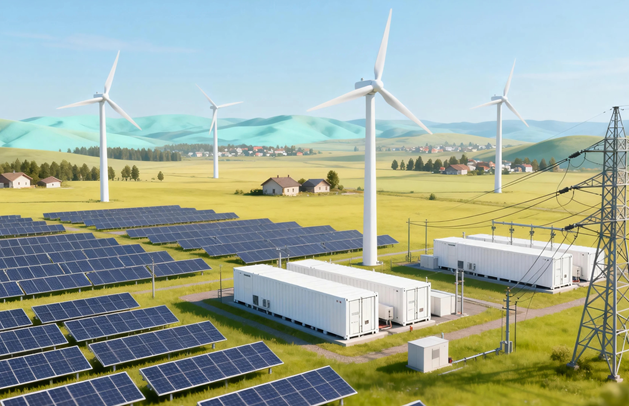
A series of targeted deployment tasks are laid out to solidify reliable substitution capacity, covering improvements in the system compatibility of wind and solar farms, integrated multi-energy development for new energy projects, and high-quality advancement of pumped storage facilities. The plan prioritises the development of new regulatory resources to strengthen the flexibility and stability of the modern power system.
Diversified adjustable resources including energy storage and flexible power loads will undertake greater system regulation responsibilities alongside optimised conventional regulation capacity. End-user-side resources will play an increasingly critical role as market mechanisms mature, supporting technological upgrades and innovative business models. Decentralised user-side resources will participate extensively in power system dispatching and interaction via virtual power plants and load aggregator operations, forming a vital supplementary source of system regulation capacity.
The dual development logic centred on power generation and breakthrough non-power utilisation defines the high-quality development path for China’s renewable energy sector during the 15th Five-Year Plan period. Expanding non-power application scenarios effectively addresses power curtailment challenges caused by limited local power consumption and constraints on long-distance power transmission in resource-abundant regions. The model also deepens and broadens the replacement of traditional fossil fuels across industrial systems.
Quantified development targets for non-power renewable energy utilisation are specified in the official plan. The total scale of non-power renewable energy utilisation will grow 1.5 times by 2030 compared with the 2025 baseline, equivalent to approximately 150 million tonnes of standard coal.
Green hydrogen, green ammonia and green methanol constitute the core sectors driving non-power industrial breakthroughs. China has cultivated solid industrial foundations after years of iterative development. By the end of 2025, domestic production capacity of green hydrogen, green ammonia and green methanol reached 250,000 tonnes, 650,000 tonnes and 380,000 tonnes respectively, accounting for more than half of global total capacity in each segment.
The current proportion of renewable energy non-power consumption in China’s overall energy mix stands at roughly 1%. The sector retains substantial room for growth to meet deep decarbonisation demands in industrial, transportation and building sectors, while further improvements in cost competitiveness are underway to match conventional fossil fuel products.
The central government will accelerate large-scale industrial deployment under the new policy framework. Integrated industrial bases for green hydrogen, ammonia and methanol will be constructed alongside large-scale new energy bases in desert, Gobi and barren land regions. National renewable energy hydrogen production capacity will reach 2 million tonnes annually by 2030. Steady progress will also advance biomass heating, biogas industrialisation and non-grain biofuel sectors including biodiesel, fuel ethanol and sustainable aviation fuel.
Continuous industrial innovation will extend the market boundary of renewable energy applications beyond power generation, covering fuel production, raw material processing, steam supply, heating services and transportation energy supply. Multi-product, multi-scenario and multi-form renewable energy utilisation will reshape the structure of China’s low-carbon industrial system and support steady progress in national energy transition.
热门内容推荐