Digital transformation reshapes summer field management across Heilongjiang’s black soil farmlands
Summer marks a critical growth phase for 230 million mu of grain crops spread across Heilongjiang’s vast black soil plains. Traditional manual field patrols are steadily making way for drone surveys, AI laser weeders and real-time monitoring via intelligent terminals. A shift towards data-driven, precise and eco-friendly summer crop management is unfolding across the region.
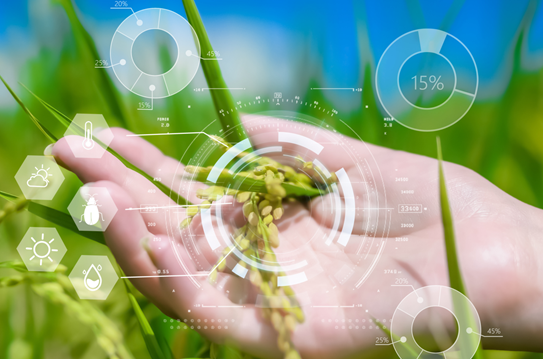
Modern field management relies heavily on digital data. Multiple locations in Heilongjiang have built air-space-ground integrated agricultural monitoring networks to deliver quantifiable insights for every stretch of farmland. Fujin, China’s largest grain-producing county, hosts a national-level agricultural science and technology demonstration park focused on rice cultivation. The park’s monitoring framework draws on satellite connectivity, internet-of-things sensors and field terminals. Seventy agronomic observation stations track crop growth and identify management gaps throughout the rice tillering stage.
Unmanned aerial vehicles carry out uniform fertilisation and plant protection work, while smart irrigation systems supply water according to actual soil moisture. Growers can access seedling conditions, soil data and pest alerts via mobile devices and receive online guidance from agricultural specialists. Similar digital transition is underway in Heihe, the city with the largest soybean planting area and output nationwide. Plant protection drones operate over large-scale soybean fields, simultaneously mapping crop conditions and tracking pest activity to overcome access limitations within dense crop stands.
Intelligent field equipment delivers operational efficiency far exceeding manual labour. Field staff deployed with portable monitoring terminals confirm drone operations achieve more than ten times the speed of manual patrols and lift fertiliser utilisation rates by 20 per cent.
Eco-friendly crop protection forms another pillar of upgraded summer management. Conventional chemical herbicides carry risks of soil residues and crop damage. New mechanical weeding solutions are now deployed across organic farmland. In Mingshui County, AI-guided laser weeding machines towed by tractors distinguish crops from weeds via high-speed image scanning and target weed growth points with focused light. Each machine can cover nearly one hundred mu per day at a fraction of the cost of manual weeding, with minimal crop damage.
Standardised cultivation techniques are being rolled out in Fujin to cut chemical input while stabilising crop health. Field teams provide on-site guidance on balanced water and fertiliser application and low-carbon pest control. Integrated technology inspection and biological pest control models on soybean bases in Bei’an reduce labour costs by 25 yuan per mu, lift pest control rates above 65 per cent and cut chemical pesticide usage by between 30 and 50 per cent. Lower contamination supports consistent improvements in soybean grain quality.
Large-scale farming operators act as primary adopters of technology-led field management. Advanced techniques including water and fertiliser integration and wide-row dense planting are widely promoted. Mobile intelligent water and fertiliser systems operate in Xinhua Township, Suihua, automatically mixing nutrients and delivering them directly to crop root zones through shallow buried drip irrigation pipelines. The equipment cuts water consumption by 40 per cent and fertiliser use by 10 to 30 per cent, and can be managed by a single operator.
Heihe’s 2,470 agricultural cooperatives and numerous commercial growers form the backbone of smart farming. The region has put 59,000 mu of land under integrated drip irrigation systems that improve water efficiency by 50 per cent and reduce fertiliser application by over 15 per cent. One large cooperative covering more than 20,000 mu has achieved full mechanised and intelligent summer management. Improved yields have encouraged further uptake among neighbouring smallholders through shared machinery and technical services.
Heihe’s agricultural authorities have deployed smart farm infrastructure with distributed sensing terminals covering more than 500,000 mu of farmland. A complete digital workflow operates from aerial surveillance and data transmission through intelligent diagnosis to targeted field operations. Ongoing investment in precision agritech supports balanced crop development across extensive farmland areas.
If you want, I can produce a condensed brief version suitable for international agribusiness news portals.
热门内容推荐