Xi’an-Chongqing high-speed rail completes full box girder erection, entering final construction phase
A key milestone has been achieved on China’s Xi’an-Chongqing high-speed railway, one of the core projects within the national eight-vertical and eight-horizontal high-speed rail network. On July 14, the final 32-metre box girder, weighing approximately 700 tonnes, was precisely positioned on the piers of the Expressway Overpass Bridge in Tongchuan District, Dazhou City, Sichuan Province, marking the full completion of the line’s box girder erection works.
Stretching 739 kilometres in total, the high-speed railway is designed for a maximum operating speed of 350 kilometres per hour. The project is constructed in two sections connecting Xi’an to Ankang and Ankang to Chongqing, with a connecting line built to link the new route with the existing Zhengzhou-Chongqing high-speed railway. Construction teams completed the erection of 408 box girders along the 17.673-kilometre section undertaken by China Railway No.4 Engineering Group.
Box girders serve as the core load-bearing structure of high-speed rail lines, bearing all track loads and forming a stable structural foundation for subsequent operations. Following the completion of girder installation, the project will advance to ballastless track paving and full-line rail laying procedures to build a robust and reliable track base.
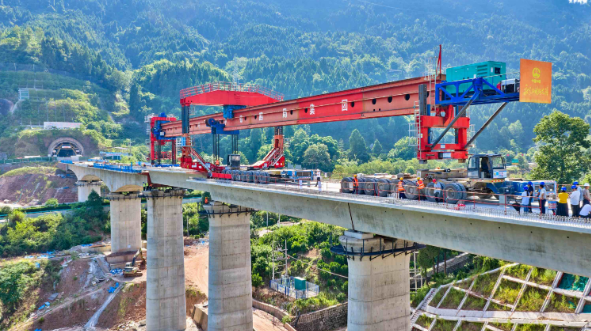
Facing complex mountainous terrain and diverse cross-construction scenarios along the route, the construction team formulated refined progress schedules and optimised the operational arrangement of bridge erecting machines and girder transport vehicles. Multiple technical and construction challenges have been overcome, including long-distance girder transportation, tunnel penetration operations, continuous beam overhead crossing and underpass construction of tied arch bridges, ensuring steady and high-quality completion of all girder erection tasks.
Once fully operational, the Xi’an-Chongqing high-speed railway will interconnect with multiple existing and under-construction trunk rail lines across central and western China, including the Chengdu-Chongqing high-speed railway, Zhengzhou-Chongqing high-speed railway and Chongqing-Kunming high-speed railway. The interconnected rail network will optimise regional transportation layouts and strengthen connectivity between northwest and southwest China.
The new rail route will substantially shorten travel times between Shaanxi and Chongqing, delivering convenient passenger travel and efficient freight logistics services. It will support consolidated achievements in poverty alleviation, facilitate rural revitalisation and urban-rural integrated development, and drive coordinated regional economic progress across western China. The completed infrastructure will further unlock developmental potential for western inland regions and underpin the high-quality advancement of the western development strategy.
热门内容推荐