World’s First Commercial Supercritical CO2 Waste Heat Power Project Fully Operational in Guizhou
The world’s first commercial demonstration project for supercritical carbon dioxide waste heat power generation, known as “Super Carbon No.1”, has achieved dual-unit full operation at the Shougang Shuicheng Iron and Steel Group plant in Liupanshui, Guizhou Province, following the successful grid connection of its second 15MW generating unit. The innovative technology has replaced century-old steam-based power generation processes and maintained stable operation at the steel production site for more than six months since the first unit entered commercial service in December 2025, continuously converting industrial waste heat into clean electric power.
Real-time operational data displayed on the central control monitoring system tracks precise temperature, pressure and operational indicators across the entire generating system. Operational statistics show that a single unit has produced over 32.856 million kilowatt-hours of electricity within six months, fully supplied for on-site plant consumption. Once the two units reach full-load operational status in August, the project will deliver a stable monthly power output of 15 million kilowatt-hours.
The new supercritical carbon dioxide power system has replaced the plant’s traditional steam waste heat power generation facility built in 2010, which featured low power output and limited waste heat utilisation efficiency. The landmark commercial project was jointly developed through collaborative technological and industrial integration. The Nuclear Power Institute of China pioneered the supercritical carbon dioxide power generation technology and promoted its commercial application, while Jigang Group provided professional engineering construction and operational capabilities. The joint cooperation has realised the industrial landing of the globally pioneering technological solution in Liupanshui.
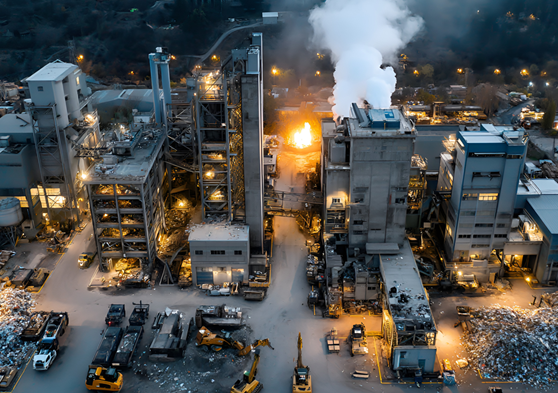
The core technological breakthrough of the project lies in its replacement of water with carbon dioxide as the heat transfer medium, overhauling the traditional water-steam power generation principle that has prevailed for over a century. Traditional thermal power generation suffers substantial energy loss during water evaporation and steam condensation cycles. Carbon dioxide reaches a supercritical state at 31 degrees Celsius and 73 standard atmospheric pressures, possessing the high density of liquid fluid and low viscosity of gas fluid, which drastically cuts energy loss during heat-energy conversion.
The research and development team has independently overcome more than 200 core technical challenges, achieving full autonomous controllability of the entire technological system. Practical commercial operation over six months has steadily improved technological maturity. Commissioning and debugging cycles have been significantly shortened, with the second unit completing full debugging and stable operation in less than three months, reflecting continuous optimisation of operational stability and system adaptability.
The new generation power system delivers remarkable improvements in energy conversion efficiency and operational performance. The sintering ore power generation capacity reaches 36 kilowatt-hours per tonne, doubling the traditional industrial advanced standard, while the thermoelectric conversion efficiency is 75 per cent higher than conventional steam power generation. The technology adapts perfectly to mountainous factory conditions in Guizhou, requiring more than 50 per cent less land than equivalent steam generating units and eliminating the need for large cooling tower facilities. Daily operation only requires two to three on-site staff members, with the system demonstrating fast response, flexible adjustment and convenient operational features throughout long-term stable operation.
The project brings tangible economic and environmental benefits to industrial production. The on-site self-generated electricity cost stands at approximately 0.5 yuan per kilowatt-hour, lower than the purchased industrial electricity tariff of 0.65 yuan per kilowatt-hour, generating substantial daily operational cost savings under full-load operation. Based on the annual sintering ore output of 5.6 million tonnes at the steel plant, the fully operational project will reduce carbon dioxide emissions by more than 50,000 tonnes annually.
The supercritical carbon dioxide power generation technology is applicable to medium and high-temperature industrial waste heat above 300 degrees Celsius, matching the waste heat characteristics of high-energy-consuming industries. Multiple enterprises have launched field inspections and business docking for technological promotion. The system can be further combined with photothermal power generation and molten salt energy storage facilities, expanding its application scenarios across diverse clean energy and industrial energy-saving fields. Ongoing technological iteration and industrial promotion will expand the scale of low-carbon waste heat utilisation across the industrial sector.
热门内容推荐