Sichuan Accelerates Major Expressway Construction to Upgrade Regional Transport Networks
Multiple provincial-level key expressway projects in Sichuan are advancing at an accelerated pace, with a string of milestone construction achievements completed during the optimal construction window. Ongoing progress on the Deyang Ring, Huili-Luquan and Zile expressways strengthens transport connectivity across central Sichuan and the Sichuan-Yunnan southern corridors, consolidating the foundational framework for the province’s high-standard comprehensive transport system.
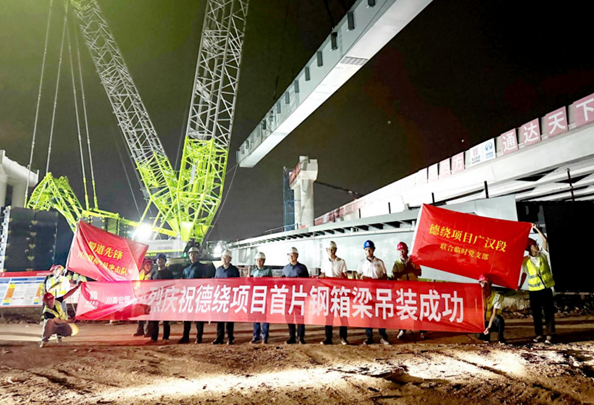
The Deyang Ring Expressway has marked a key construction breakthrough with the successful hoisting of its first full steel box girder. Conducted at the Songlin Interchange Ramp Bridge, the operation lifted a 60-metre-long, 2.3-metre-wide steel box girder weighing 171 tonnes into precise position. The milestone officially launches the full-scale construction of the bridge’s superstructure.
The hoisting work involved complex cross-operation above existing expressways, with constrained temporary road closure windows, millimetre-level positioning requirements and limited construction space. Pre-operation trial lifts, comprehensive safety hazard inspections and repeated parameter calibration were implemented to overcome technical challenges and ensure high-quality construction delivery.
Stretching 60.987 kilometres, the Deyang Ring Expressway adopts a four-lane design with a maximum speed of 120 kilometres per hour and a bridge-tunnel ratio of 56.6 per cent. The project carries a total investment exceeding 16.669 billion yuan over a four-year construction period. Upon completion, it will connect major economic and industrial zones including Kaizhou New Town, Deyang High-tech Zone and Deyang Economic Development Zone, optimising local road networks, improving traffic conversion efficiency and reinforcing internal links within the Chengdu Plain Economic Zone.
The ZCB1-3 section of the Huili-Luquan Expressway in Liangshan Yi Autonomous Prefecture has achieved full-line completion. Covering 10 kilometres, the section boasts an extremely high bridge-tunnel ratio of 94 per cent, comprising six large bridges, two medium bridges, one super-long tunnel and multiple roadbed sections. Faced with restricted mountainous terrain, complex geological conditions and tight construction schedules, the project team adopted innovative construction models tailored to local conditions.
A smart beam yard integrating fixed prefabricated platforms and mobile hydraulic formwork has been built for mountain construction, supported by fully automated numerical control steel processing equipment and intelligent material management systems. The full-process digital control system effectively addresses technical bottlenecks in mountain infrastructure development.
Spanning 47.7 kilometres in total, the Huili-Luquan Expressway is designed for speeds of 80 kilometres per hour with a total budget of 7.78 billion yuan. It connects the Dechang-Huili Expressway in Sichuan and links with the planned Wudongde-Luquan Expressway in Yunnan. The route will cut travel time between Huili and Kunming from five hours to 3.5 hours upon full opening, forming a new interprovincial transport corridor between southern Sichuan and northern Yunnan. The upgraded network will drive coordinated development between the Panxi Economic Zone and central Yunnan urban agglomerations.
The Zile Expressway has commenced large-scale bridge erection works following the successful installation of the first beam at the No.2 beam yard of its TJ3 section in Baofei Town, Renshou County. The 24.94-metre-long prestressed concrete beam adopts C50 high-strength concrete and serves three local bridges, unlocking phased large-scale structural construction progress across the project.
With a total length of 93.3 kilometres, the Zile Expressway features a six-lane layout and a design speed of 100 kilometres per hour, connecting Zizhong County with the existing Tianmei-Leshan Expressway. The project will further optimise the expressway network of the Chengdu-Chongqing Twin-City Economic Circle, enhance transport links within southern Sichuan urban clusters and support integrated development of regional industrial and resource sectors.
All three key expressway projects will continue advancing systematic construction and phased commissioning in subsequent stages. The continuous improvement of Sichuan’s intercity and interprovincial road networks will further unlock regional resource advantages and underpin steady high-quality economic development across western China.
热门内容推荐