Cross-Regional Power Trading Bolsters Summer Supply as China’s Unified National Power Market Takes Shape
Clean wind and solar generation from north-western China delivers cooling power to the Pearl River Delta amid sustained summer heat, while hydropower output from the Yunnan-Guizhou Plateau feeds manufacturing lines across the Yangtze River Delta. Cross-regional power trading mechanisms deliver vital operational support for national electricity supply during peak summer demand periods.
The Outline of the 15th Five-Year Plan sets out targets to complete the rollout of a unified national power market framework. Annual growth in market-based traded power volumes averaged 16.0 per cent through the 14th Five-Year Plan cycle. Full-year market trading volumes in 2025 stood 109.7 per cent higher than the closing year of the 13th Five-Year Plan, with marketised electricity accounting for more than 60 per cent of total social power consumption for four consecutive years. Fundamental shifts have reshaped national power resource allocation models. By the end of 2025, provincial spot power markets had been established across all administrative regions, forming the initial architecture of a unified national power network and shifting the sector away from rigid planned power allocation towards market-driven electricity circulation.
Temperatures have climbed nationwide, pushing aggregate power demand to successive record highs. National electricity load hit an all-time peak of 1.551 billion kilowatts on 14 July, with maximum inter-provincial and cross-grid power transmission capacity reaching 278 million kilowatts to sustain stable supply nationwide. Real-time data covering supply and demand across five southern provinces and cross-grid transmission schedules are displayed on large monitoring screens at the Guangzhou Power Trading Centre.
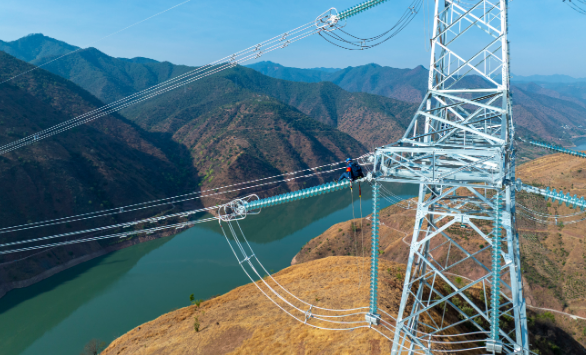
Spatial mismatches between regional power supply and demand unlock spare transmission capacity on interconnection corridors linking separate grid operating zones. Two major interconnection projects between State Grid and China Southern Power Grid, the Jiangcheng DC link and Min-Yue Interconnection, operate at full continuous output to deliver power into Guangdong. Completed cross-regional trades transmitting power from central China and Fujian to Guangdong have totalled 10.8 billion kilowatt-hours, reinforcing secure power supply for peak summer operations.

Formalised regular cross-grid trading has smoothed nationwide power circulation. In July 2025, the National Development and Reform Commission and National Energy Administration approved a formal framework for recurring power transactions between State Grid and China Southern Power Grid operating territories. Total cross-grid traded power under this mechanism reached 3.4 billion kilowatt-hours across 2025.
A senior official from China Electric Power Planning & Engineering Institute draws parallels between the national power market and a national highway network. Cross-grid trading creates interoperability between separate transmission system frameworks, while inter-provincial trading routes function as major arterial highways and provincial internal market platforms form local feeder road networks. A multi-layered, multi-commodity, multi-functional power market framework has matured through 2025, marked by full provincial spot market coverage, regular cross-grid transaction cycles and continuous operation of the southern regional power market. These milestones underpin the initial formation of a unified national power market system.
Market-traded electricity volumes hit a new high in 2025, exceeding 6.6 trillion kilowatt-hours. The market share of traded power rose from less than 15 per cent of total social consumption in 2015 to 64 per cent. Inter-provincial and cross-regional transaction volumes reached 1.6 trillion kilowatt-hours, a more than tenfold increase over levels recorded a decade earlier. Officials from the National Energy Administration confirm ongoing refinements to regular cross-grid trading frameworks to strengthen peak shifting, cross-region surplus balancing and emergency mutual support capacity across regional power systems.
A flexible market pricing framework has been fully established to reflect real-time supply and demand balances and drive efficient resource allocation. A dynamic pricing system that rises and falls in line with market conditions has replaced fixed historical tariff structures. On-grid tariffs for coal-fired generation and commercial consumer power prices adjust dynamically according to market fundamentals, with price signals acting as a core lever for optimising power resource distribution.
Real-time pricing data updates continuously on display panels at the Shandong Power Spot Market operation centre in Jinan, with stepped price curves recalculated every fifteen minutes to generate 96 distinct price points each day, capturing granular shifts in local power supply and demand.
Real-time spot prices operate as transparent market signals that regulate both generation and consumption sides. The Shandong spot market has maintained stable continuous operation for 55 months as of late June, with nearly 1.9 trillion kilowatt-hours settled through market-based transactions.
On the generation side, flexible market pricing incentivises targeted output adjustments from thermal power fleets. When wind and solar generation surpluses push prices lower, coal-fired units reduce load output. During evening demand peaks when renewable generation falls away and consumption surges, market prices climb to reward thermal generators and energy storage assets that ramp up discharge to maintain system stability. Operators of coal-fired facilities now adjust output according to price signals rather than prioritising constant maximum generation volumes.
Industrial power users adjust production schedules to cut operational expenditure on the demand side. Energy-intensive manufacturing facilities with flexible production workflows shift high-load processing from expensive evening peak periods to midday windows when solar generation suppresses tariffs. This scheduling strategy reduces corporate power expenditure, eases system peak pressure and improves overall absorption of renewable power output.
The completion of a unified national power market has completed the transition from planned power dispatch to market-based allocation, with electricity prices determined primarily by supply and demand dynamics. Market liquidity unlocks flexible adjustment capacity across generation and consumption segments.
Novel market participants with flexible load and storage assets now take an active role in power trading, diversifying transaction counterparties and traded products to create a multi-buyer, multi-seller market landscape.
A landmark spot power settlement was completed in Guangdong recently, involving three large hyperscale data centre clusters operated by China Unicom Shaoguan, China Mobile Guangzhou and China Mobile Zhanjiang. The facilities participated in formal energy trading and settlement via the virtual power plant operation platform managed by Guangdong Energy Investment Co., Ltd.
Virtual power plants do not constitute physical generation facilities, but integrated digital platforms that aggregate dispersed grid assets including charging stations, energy storage systems and distributed renewable generation to participate in grid dispatch and market transactions. The State Council General Office issued policy guidance in February 2026 encouraging flexible participation in power markets from virtual power plants, intelligent microgrids and adjustable consumer loads.
This Guangdong settlement represents the first instance of large-scale data centre fleets accessing provincial spot markets via virtual power plant aggregation. The platform adjusts data centre power draw in response to real-time spot prices to maximise operational returns. Aggregated computing loads are reduced during high-price trading windows by deprioritising non-urgent computing tasks, while processing activity is scaled up during low-tariff periods to absorb surplus power supply.
Pilot activity involving novel market participants unfolds across regional markets. More than 400 registered virtual power plant operators and independent energy storage providers were active nationwide by the close of 2025.
Senior research staff at the energy policy and market institute of China Electric Power Planning & Engineering Institute outline the benefits of integrating flexible assets such as virtual power plants into trading frameworks. Expanded participation diversifies market counterparties and transaction varieties, delivering more precise price signals and more efficient national resource allocation while aligning market architecture with the technical requirements of new power systems. Individual flexible assets can select suitable trading windows and commodity products according to their operational characteristics to deliver targeted system support.
National energy sector data records steady expansion of cross-regional clean power transmission corridors, with wind, solar and hydropower from resource-rich inland provinces continuously channelled to high-demand coastal industrial hubs. Ongoing upgrades to interconnection infrastructure and transaction rules will expand the scale of cross-grid power exchange and strengthen the overall resilience of the national electricity supply network through subsequent peak demand cycles.
热门内容推荐