Chinese Consumer 3D Printing Exports Surge on AI Vision Integration, Firms Build Cross-Sector Tech Platforms
According to China General Administration of Customs statistics, shipments of consumer 3D printers from China record robust growth across the first five months of the year, with 2.94 million units exported, marking a 90 per cent year-on-year rise. Export value reaches 7.82 billion yuan, up 106.8 per cent over the same period a year earlier. Driven by artificial intelligence and spatial computing breakthroughs, the whole 3D printing sector undergoes structural shifts, with industry competition shifting from hardware metrics such as print speed and precision to full-spectrum capabilities covering 3D data capture, intelligent modelling, in-process control and post-print quality inspection.
A strategic partnership sealed in April sees Orbbec and Creality join forces to launch an AI vision intelligent platform tailored for additive manufacturing workflows. The collaboration unites strengths in depth vision hardware and consumer-grade printing equipment, embedding intelligent sensing modules into mainstream printing pipelines.
A senior representative from Orbbec’s scanning and innovation division spoke exclusively to Securities Daily, outlining three core evaluation benchmarks guiding the group’s expansion into additive manufacturing. The team prioritises real-world deployment of its technical solutions, consistent large-scale client delivery frameworks, and reusable foundational platforms spanning software, hardware and supply chain coordination.
Market observers view the company’s entry into 3D printing as a separate commercial venture, yet internal planning frames the move as an extension of existing robotic vision technology portfolios rather than a standalone new business line. Robotic vision systems are engineered to enable machines to interpret physical environments, covering object identification, spatial navigation, obstacle avoidance and automated grasping, all built upon unified depth perception, spatial reconstruction and advanced algorithm frameworks. Consumer 3D printing workflows share identical underlying technical foundations, relying on 3D scanning, digital model reconstruction and spatial data processing at the pre-production stage, despite divergent end-use scenarios.
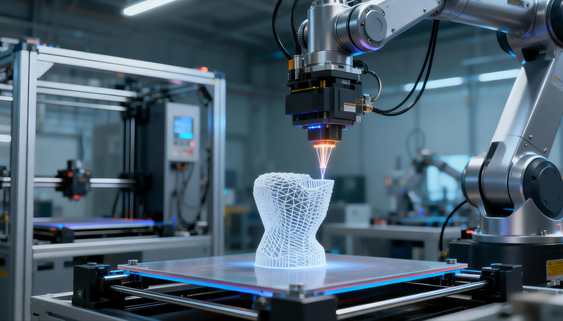
Traditional additive manufacturing workflows require operators to complete discrete steps including scanning, digital modelling, mesh repair, slicing and physical printing, each dependent on separate software suites and specialist technical knowledge, a major barrier restricting mainstream consumer adoption. AI vision technology streamlines fragmented workflows into unified, automated pipelines, with intelligent sensing set to operate across every production stage rather than solely within scanning and modelling phases.
Prior to printing, integrated AI vision hardware delivers automated object recognition, complete 3D reconstruction and digital data refinement to cut technical barriers for amateur users. During ongoing printing operations, real-time visual monitoring identifies common manufacturing faults including poor first-layer adhesion, filament jams, nozzle blockages and model warping, triggering automated print pauses, parameter recalibration and real-time error correction. After production finishes, vision systems run automated comparative checks between finished physical parts and original digital models, flagging dimensional deviations and structural defects, with feedback data fed back to optimise subsequent printing parameters to form closed-loop quality management.
This technical framework has been commercialised via Pika, a pocket-sized AI 3D scanner jointly developed by the two partnering firms. The device measures roughly 100mm by 60mm by 35mm and weighs 260 grams, supporting direct smartphone connection for instant scanning operations. Miniaturised hardware creates new technical hurdles, with engineering teams balancing compact physical design against stable scanning precision and user experience.
R&D teams adopt a dual-track development strategy combining miniaturised hardware architecture and algorithmic intelligence. Optimisations span structural layout, component integration and optical design to shrink overall device dimensions, while AI algorithms enhance real-time target tracking, three-dimensional mesh reconstruction and automated geometry completion. Human portrait scanning workflows benefit noticeably from intelligent mesh repair algorithms, which autonomously refine intricate details such as hair strands and fabric folds without manual post-processing, further lowering operational thresholds for casual users.
All future generations of 3D printing hardware will incorporate multi-layer intelligent capabilities, combining mechanical structures, consumable materials, AI algorithms, vision sensors, software platforms and automated control modules. The company’s market entry centres on transferring its mature robotic and AI vision technical base into broader digital manufacturing verticals.
As a new market participant, Orbbec does not release self-branded 3D printing hardware, instead positioning itself as an upstream technology enabler that participates in client product development cycles through Joint Design Manufacturing frameworks. Conversations with industry partners reveal shifting purchasing demands across the sector, with most manufacturers now seeking end-to-end integrated solutions covering vision sensing, algorithm processing, hardware engineering and mass production rollout, rather than standalone vision component procurement.
Rising industry intelligence levels push software and platform-based services to carry greater commercial weight within the additive manufacturing ecosystem. Near-term sales volume growth carries less strategic weight than robust product deployment capacity, stable mass delivery pipelines and deep collaborative ties with downstream manufacturers. Sustained commercial viability hinges on addressing tangible industrial demands, with steady progress prioritised to solidify product development, mass production, order fulfilment and client support systems before scaling business footprints.
Chinese enterprises hold dominant global market share within consumer 3D printing, accounting for approximately 90 per cent of worldwide consumer equipment shipments. The current growth cycle draws support from elevated domestic manufacturing capacity, expanding real-world application scenarios and rapid maturation of AI auxiliary technologies.
Years of industrial development have built comprehensive domestic supply chains for consumer additive manufacturing hardware. Falling equipment prices coincide with consistent upgrades to print speed, operational stability and multi-material, multi-colour printing performance, expanding the target user base beyond professional engineers and makers to educational institutions, micro-enterprises and general household consumers.
AI auxiliary tools further simplify user operations, with automated modelling, mesh repair, intelligent slicing, self-calibration and in-print monitoring removing complex manual technical workflows and making digital creation accessible to broader demographics. Core market opportunities lie in continuous reduction of technical barriers to three-dimensional design and digital fabrication. Portable scanning hardware, unified end-to-end pipelines covering scanning, modelling, slicing and printing, alongside dedicated inspection, reverse engineering and digital twin tools for industrial and specialist applications, form key development trajectories for the whole sector.
Long-term corporate strategy prioritises scalable platform technology rather than single hardware product lines. Established robotic vision operations deliver full-stack capabilities covering sensor modules, technical solutions and mass manufacturing, and the firm intends to replicate this complete value chain layout within additive manufacturing, spanning raw spatial data capture, digital model refinement and physical printing output. Modular, expandable technical frameworks built around partner requirements will remain central to its development roadmap, instead of concentrating resources on isolated hardware or single algorithmic modules.
Additive manufacturing represents a long-term industrial opportunity generated by deep integration between AI vision, spatial computing and smart manufacturing, rather than a passing market trend. Ongoing expansion into digital manufacturing use cases will continue to build upon the firm’s core vision technology foundation, with new commercial avenues explored in line with technical maturity, downstream client requirements and verified commercial performance metrics.
热门内容推荐