China Completes Nation’s First Inland Liquefied Biomethane Bunkering Operation on Yangtze Waterway
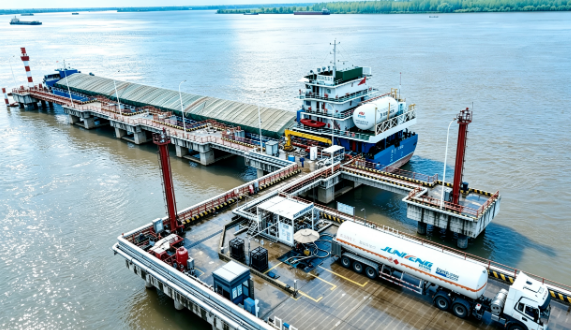
According to domestic shipping industry dispatches, China Marine Fuel, a subsidiary of COSCO Shipping, has partnered with Huaihe Energy and Marriott Energy to deliver the country’s maiden liquefied biomethane refuelling for inland waterway vessels at Wuhu, Anhui Province. The bunkering work was carried out alongside the moored vessel Kaixing 1307, marking a definitive shift for green fuel supply on the Yangtze from small-scale pilot demonstrations to large-scale commercial roll-out of renewable biofuels.
Green transition for Yangtze inland shipping has long been restrained by narrow low-carbon fuel options and constrained supplies of renewable energy feedstock. Liquefied biomethane addresses these structural limitations, combining renewable feedstock origins, substantial lifecycle emissions cuts and broad compatibility with existing marine power systems to deliver a viable new pathway for decarbonising river transport routes.
The fuel is manufactured from crop straw, forestry residues and other organic agricultural waste streams. Full lifecycle greenhouse gas emission reductions exceed 80 per cent, while nitrogen oxide output falls by 85 per cent and particulate matter by 99 per cent compared with conventional fossil marine fuels. A defining operational advantage lies in its plug-and-play compatibility: existing dual-fuel LNG vessels require no hardware retrofits before receiving liquefied biomethane bunkers. This characteristic removes a key financial and technical barrier that has slowed carbon abatement across inland fleets, resolving the industry-wide mismatch between decarbonisation targets and limited accessible green fuel supplies.
Close cross-party collaboration between the three participating operators underpinned the landmark bunkering trial, establishing an end-to-end commercial value chain covering biomass waste gasification, onshore centralised storage and transportation, floating bunkering terminals and onboard vessel consumption. The integrated operational framework creates a replicable commercial model for deep decarbonisation across the national inland waterway network.
Regulatory frameworks for green inland shipping continue to expand across Yangtze river provinces, with local authorities rolling out dedicated storage terminals and floating refuelling stations to accommodate rising volumes of low-carbon biofuels. Operators will replicate the complete biomass-to-bunker supply model at additional port hubs along the Yangtze main channel and its tributaries. Further field trials of liquefied biomethane bunkering will proceed to standardise refuelling workflows, streamline logistics coordination between biomass processing plants and waterfront storage facilities, and expand the range of inland vessel categories eligible to adopt the renewable fuel mix.
热门内容推荐