Foshan Station on Guangzhou-Zhanjiang High-Speed Rail Opens to Passengers, Delivering Urban High-Speed Rail Access to Central Foshan
SHANGHAI, 1 July — As reported by China Daily, Foshan Station, a core transport hub built and funded by Guangzhou-Zhanjiang Railway Company under Guangdong Railway Investment Group, enters full passenger operation on 1 July. The launch brings high-speed rail services into central Foshan, ending the city’s long absence of downtown high-speed rail connections and adding a vital node to the high-speed rail network spanning the Guangdong-Hong Kong-Macao Greater Bay Area.
The station is built to a configuration of three platforms and seven tracks, with reserved capacity to expand to four platforms and nine tracks. Its long-term designed annual passenger throughput stands at six million people, while the combined floor area of station buildings and auxiliary facilities reaches roughly 294,000 square metres. A pioneering vertical layout is adopted across two above-ground levels and three underground storeys, with dedicated zones allocated for high-speed rail services, metro lines, mechanical equipment, vehicle parking and pedestrian urban corridors respectively.
Architectural design draws inspiration from magnolia grandiflora, the city flower of Foshan, carrying the thematic concept of “Blossoming Magnolias in the Splendid Bay Area”. Curved rooflines and fluid side facades blend contemporary architectural aesthetics with distinctive Lingnan regional styles. Cultural motifs intrinsic to Foshan, including lion dance imagery, martial arts elements and traditional wok-ear gable designs, are integrated seamlessly throughout indoor and outdoor spaces, enabling travellers to engage with local cultural heritage during waiting periods.
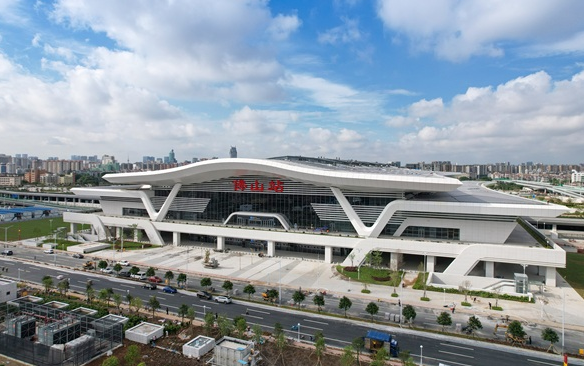
Once operational, Foshan Station forms interchange links with the Guangzhou-Zhanjiang, Beijing-Guangzhou and Guangzhou-Shanwei high-speed rail lines, unlocking northbound transport corridors for Foshan and delivering direct services to major urban centres including Guangzhou, Shenzhen, Changsha and Wuhan. The hub will ease passenger congestion at Guangzhou’s major railway terminals through diverted passenger flows. A regular timetable of 98 passenger services will run each day, with 34 routes heading towards Zhanjiang North Station as the most frequent service. The fastest journey between Foshan and Guangzhou takes just 18 minutes, while travel time from Foshan to Zhanjiang North is cut to under one and a half hours. Such sharp reductions in cross-regional travel durations support the formation of a 1.5-hour commuter living circle across the Greater Bay Area and reinforce coordinated regional development.
The construction site sits within the historic heart of Chancheng District, characterised by constrained land space and dense underground utility pipelines. Three metro lines, namely Line 3, Line 7 and Line 15, will connect to the station, introducing elevated geological risks and complex overlapping construction phases. As the project developer, Guangzhou-Zhanjiang Railway Company coordinated multiple stakeholders with guidance and backing from Guangdong Railway Investment Group and China Railway Guangzhou Group. Construction teams worked round the clock to accelerate delivery timelines, resolving a series of complex obstacles including urban centre construction constraints, utility pipeline relocation and concurrent multi-layer building works. Full technical acceptance and comprehensive safety evaluation procedures were completed to stringent industry standards.
The Guangzhou-Zhanjiang High-Speed Railway represents Guangdong’s self-funded flagship rail project, distinguished by its technical complexity, full-line length of 401 kilometres and substantial total investment. The line operates at a design speed of 350 kilometres per hour and opened for full mainline traffic at the close of 2025. The commissioning of Foshan Station establishes robust northward and westward rail arteries for Foshan, alongside a planned 9.3 square kilometre high-speed rail future city zone anchored around the station precinct to advance integrated industrial and urban growth.
Moving forward, Guangzhou-Zhanjiang Railway Company will continue coordinating with relevant authorities to upgrade interchange infrastructure and refine passenger service frameworks. Improved connectivity will streamline transport links between the Guangdong-Hong Kong-Macao Greater Bay Area, western Guangdong and the Beibu Gulf region, with premium high-speed rail infrastructure sustaining delivery of the province’s 100 Counties, 1,000 Townships and 10,000 Villages High-Quality Development Initiative.
热门内容推荐