Autonomous Underwater Robots Deployed for Pile Inspection at China’s Largest Tidal Flat PV Scheme in Lianyungang
According to China Energy News, construction advances at CNNC Tianwan 2GW tidal flat photovoltaic demonstration project, the nation’s largest offshore solar facility, situated along the Yellow Sea coast of Lianyungang. Two domestically developed autonomous underwater pile inspection robot systems, engineered by China National Nuclear Corporation, have entered sea trials after completing rigorous freshwater testing, introducing a dedicated subsea inspection fleet to the 28,000-mu marine energy complex.
More than sixty thousand pre-stressed concrete tubular piles form the foundational substructure of the vast offshore PV array. The newly deployed robotic units deliver comprehensive, precise and intelligent subsea scanning to monitor structural integrity, delivering robust technical safeguards for consistent, secure operation of the offshore power plant.
Marine piles sunk dozens of metres into the seabed face persistent corrosive threats including pitting, crevice degradation and microbe-induced erosion, slow structural damage that undermines long-term service life and power supply reliability. The research team developed fully autonomous underwater hardware tailored to complex coastal marine environments to address this persistent operational challenge. Each robot integrates high-definition optical cameras and sonar acoustic sensors to manoeuvre close to pile surfaces for full surface scanning. Onboard artificial intelligence processing units analyse captured imagery to automatically identify corrosion, structural cracks and marine biofouling with a recognition accuracy rate of no less than 95 per cent.
Early design stages presented substantial technical barriers, with sustained power supply standing as the most critical hurdle. Conventional underwater craft rely on trailing power cables that restrict operational range, or require repeated vessel retrieval for battery replacement, a labour-intensive process that shortens equipment service life. The team integrated magnetic resonance wireless power transfer technology to enable uninterrupted remote power feeding for subsea robots. The custom-built subsea wireless charging platform delivers a single-unit charging capacity of 10 kilowatts with underwater energy transmission efficiency exceeding 90 per cent, cutting operational downtime and boosting the throughput of structural defect detection tasks.
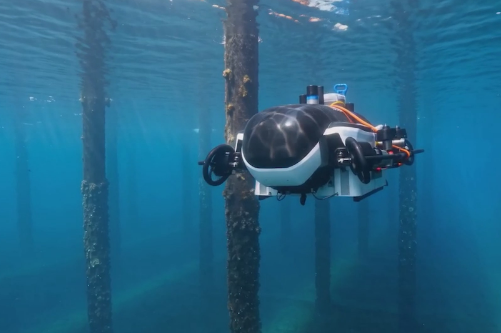
A second core technical breakthrough centres on high-precision underwater positioning and autonomous navigation. Extensive iterative simulation testing refined flight control algorithms, enabling the robots to complete static hovering, complex S-shaped transit paths and close-circling manoeuvres around vertical piles. Positioning accuracy has been drastically improved, limiting positional deviation to under two metres over a kilometre of travel, laying stable groundwork for independent cruising and detailed structural scanning.
Months of closed-loop training took place at a freshwater aquaculture-solar hybrid test facility operated by CNNC Jiangsu subsidiary in Changshu, covering eight core assessment modules: positioning precision, autonomous docking and recovery, wireless charging, dual-robot collaborative scheduling and full operational simulation. Multiple operational obstacles emerged during trials: cross-flow water currents caused lateral drift during docking; loose internal fasteners within charging stations reduced power transfer efficiency; competing charging demands created scheduling conflicts when two robots operated simultaneously. Engineers split the docking sequence into four progressive phases of long-range approach, mid-range adjustment, close alignment and cage entry, tuning control parameters at every stage. Anti-loosening sealants were applied to all critical fasteners on wireless charging hardware, while an intelligent task scheduler allocates charging priority to low-power units or those carrying high-priority inspection assignments. Iterative calibration stabilised system performance, with robot docking success rates maintained above 90 per cent and 100 per cent functional reliability for wireless charging safety interlocks. Dual-robot fleets complete extended parallel inspection runs without operational conflict.
Upon finishing full closed-loop validation in the Changshu test basin, the autonomous inspection systems attained full operational certification for deployment in real coastal marine conditions. All pile and trestle construction work for subarray 207 of the Tianwan PV project has been finished, with dedicated underwater bracket structures installed to house wireless charging stations and recovery cages. Natural tidal shifts, wave turbulence and turbid seawater will now validate the fleet’s capacity to deliver regular, fully automated structural monitoring for offshore photovoltaic pile foundations.
The field deployment of these indigenous robotic inspection systems establishes a replicable technical framework for intelligent subsea asset maintenance, applicable to large-scale offshore photovoltaic parks and offshore wind turbine foundations across coastal waters. Further optimisation of underwater navigation and wireless charging hardware will roll out alongside ongoing construction phases of the Tianwan tidal flat PV scheme, supporting continuous expansion of automated marine energy infrastructure monitoring workflows.
热门内容推荐