Distributed Wind Farm at Weifang Central Port Tops 100 Million kWh of Green Power Generation
New operational figures from Bohai Bay Port under Shandong Port Group confirm the distributed wind power scheme at Weifang Central Port has surpassed 100 million kilowatt-hours of cumulative power output. The facility reached full-capacity grid connection on 30 September 2024 and has maintained consistent, efficient operation ever since, marking tangible progress in the port’s low-carbon transformation and delivering robust renewable energy support for the development of zero-carbon terminals and integrated wind-solar-hydrogen energy infrastructure.
The coastal wind farm sits within Weifang Central Port, stretching from the west bank of Bailang River Estuary to the eastern side of Laohu River Estuary, with wide open terrain yielding abundant wind resources. Four wind turbines each rated at 6.7 megawatts form the core hardware, delivering a total installed capacity of 26.8MW. Matching energy storage equipment offering 20% power capacity and two-hour discharge duration is integrated into the layout, adopting the widely proven operational framework of self-consumption on site with surplus power exported to the public grid.
Total investment for the development stands at approximately 200 million yuan, with a designed annual generation volume of 98.79 million kWh and an average usable annual output of 69.15 million kWh. The attached storage system smooths out volatile wind generation fluctuations once operational, lifting green electricity absorption rates and supply reliability while sustaining high equipment utilisation to hit the 100 million kWh generation milestone.
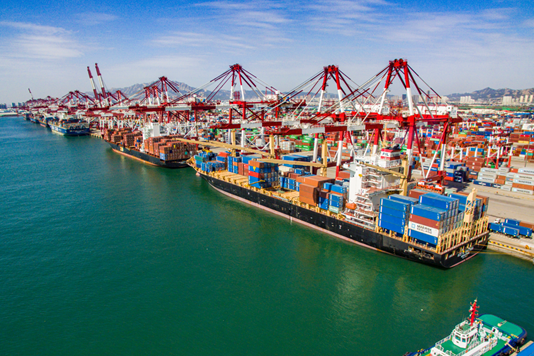
On-site power consumption takes priority under the project’s operational rules, with all clean power generated first feeding dock handling machinery, storage yard operations and on-site office facilities. Any excess electricity is channelled into the municipal power grid. Operational calculations indicate the port cuts annual external grid power expenditure by roughly 9.6 million yuan. Since cumulative generation crossed 100 million kWh, the volume of purchased mains electricity has fallen substantially, trimming overall operational energy costs and underpinning stable, cost-effective port operations.
The integrated wind and storage framework creates a closed loop of on-site renewable generation and consumption, establishing a replicable demonstration model for port operators to drive down overheads through clean energy deployment and reinforcing the solid foundations of Shandong Port’s real economy.
Every 100 million kilowatt-hours of zero-carbon electricity delivers measurable environmental gains. Continuous operation of the wind farm has saved more than 21,000 tonnes of standard coal and cut carbon dioxide emissions by 57,000 tonnes, alongside reductions of 1.5 tonnes of soot, seven tonnes of sulphur dioxide and 10.5 tonnes of nitrogen oxides. Reliance on fossil-fuel grid power for port activities falls steadily, lowering atmospheric pollutant concentrations across the port zone and surrounding coastal areas.
As a core infrastructure asset for Bohai Bay Port’s zero-carbon terminal blueprint, the large-scale distributed wind installation accelerates the rollout of unified wind, solar and hydrogen energy systems across port premises, offering a practical, transferable template for ports targeting carbon peaking and carbon neutrality benchmarks.
Sustained precise operational management underpins stable maximum output. The coastal site faces harsh working conditions including high salt mist and erratic strong winds, prompting on-site maintenance crews to implement closed-loop workflows for regular equipment inspections and hazard elimination. Dedicated overhaul cycles are scheduled for wind turbines and energy storage units, while intelligent storage regulation maximises capture of coastal wind resources by adhering to a strategy of harnessing every available gust and every unit of generated power.
Frontline operational staff embed workplace safety protocols into daily upkeep routines, tightening multi-layered safety oversight to secure long-term stable, high-efficiency generation and unlock further renewable power potential.
The milestone of 100 million kWh cumulative output validates the full-scale stable operation of the distributed wind scheme at Weifang Central Port and verifies the practical advantages of integrated wind-storage layouts tailored for port zones.
Shandong Port Group will scale up renewable energy industrial development, advancing forward-looking deployment of hydrogen energy and large-scale energy storage assets alongside upgraded green energy infrastructure within port boundaries. New application scenarios for wind and solar power will be rolled out to build modern port facilities defined by low-carbon emissions and resource-efficient operation.
热门内容推荐