Twenty Years of Qinghai–Xizang Railway: Engineering Excellence and Sustainable Plateau Development
According to official Chinese media releases, July 1 marks the 20th full opening anniversary of the Qinghai–Xizang Railway, an iconic high-altitude transport artery stretching across the Roof of the World with an average elevation of over 4,000 metres. As the core force behind the railway’s construction and long-term operation, China Railway Construction Corporation has undertaken the full-spectrum work including survey, design, construction, maintenance and iterative upgrading of the landmark project over two decades, delivering enduring engineering achievements under extreme alpine conditions.
The Golmud–Lhasa section of the Qinghai–Xizang Railway officially commenced construction in 2001, confronting three unprecedented geological and environmental challenges that had long blocked large-scale infrastructure development on the plateau: perennial frozen soil, severe cold and oxygen deficiency, and fragile ecological systems. China Railway Construction undertook the entire design work, 72 per cent of the overall construction tasks, and all construction operations at altitudes above 4,900 metres along the route.
At the Fenghuoshan Tunnel site, where ambient oxygen levels drop to less than half of those in inland regions, professional construction teams developed large-scale tunnel air-conditioning units and built the world’s highest-altitude on-site oxygen generation station, enabling full-section diffused oxygen supply inside the tunnel. The project pioneered an active cooling technology framework for frozen soil treatment, conducting refined classification of the 550-kilometre frozen soil segment and resolving long-standing global technical barriers to railway construction on perennial frozen ground. The Fenghuoshan Tunnel, with a rail surface altitude of 4,905 metres, was completed within just over one year.
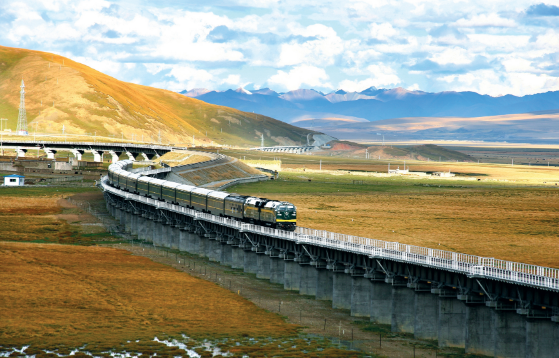
Spanning the uninhabited Hoh Xil region, the 11.7-kilometre Qingshui River Extra-Large Bridge stands firmly above frozen soil layers. More than 1,300 bridge openings are reserved as dedicated migration passages for Tibetan antelopes and other wild fauna, setting a benchmark for harmonious coexistence between major engineering works and plateau ecosystems. Construction teams overcame ultra-low temperature concrete pouring difficulties at the Sancha River Extra-Large Bridge, and extended the railway to the world’s highest railway altitude of 5,072 metres at the Tanggula Pass.
A series of core technological innovations developed during the project have formed a complete set of independently patented technologies for railway construction on plateau frozen soil. The railway has secured more than ten world records, covering the highest operating altitude, longest line mileage and fastest running speed among high-altitude rail routes globally.
Continuous technical upgrading and capacity expansion have underpinned steady operational improvements of the plateau rail network. The Lhasa–Shigatse Railway, designed and built by China Railway Construction, opened for service in 2014, extending the Qinghai–Xizang Railway network further westward. The launch of the Lhasa–Nyingchi Railway in 2021 ushered in the EMU era for Xizang, transforming the single linear rail route into a Y-shaped network centred on Lhasa.
To address capacity constraints on the classic Golmud–Lhasa section, major capacity expansion works were completed in 2018, adding 13 new stations across the line. The upgrade cut freight train travel time by two hours and lifted overall transport capacity by 80 per cent. Full-scale system optimisation continued in 2023, with comprehensive renovation of signal systems at 56 stations and replacement of 126 turnouts. The full localisation of CTC dispatching systems and turnout equipment has strengthened operational safety and independent technological controllability. In March 2026, external power supporting works for the electrification renovation of the Golmud–Lhasa section officially started, initiating a new phase of green and low-carbon operation for the high-altitude railway.
Frontline maintenance teams have maintained rigorous operational standards across decades of plateau service. Female rail flaw detection teams conduct daily manual inspections with over 20-kilogram testing instruments along the rail tracks, while female signal maintenance teams deliver zero-error performance on thousands of welding points. Both teams have received national industry honour titles for outstanding female work collectives. The Anduo maintenance workshop, stationed at 4,702 metres above sea level, systematically rectifies frozen soil damage and water hazards, safeguarding the safe operation of 146 kilometres of main track and delivering consistent professional maintenance services.
Ecological protection has remained a core principle throughout the railway’s entire lifecycle. Strict environmental protection standards were established at the initial survey stage, with systematic environmental management guidelines compiled in collaboration with professional research institutions. The project pioneered third-party environmental supervision and dynamic ecological monitoring mechanisms for railway construction in China.
Advanced engineering solutions including ventilated roadbeds and bridge-based road replacements have been adopted to stabilise frozen soil foundations, keeping roadbed subsidence rates at the lowest global level for similar projects. Construction waste residues were transported to abandoned road foundations to avoid damaging alpine meadows. Conservation works include 587,200 square metres of turf transplantation and 64,000 metres of ecological drainage ditches. An 80,000-square-metre artificial wetland was built at Gulu Station, creating a sustainable ecological restoration model for high-altitude regions. Construction teams voluntarily suspended on-site operations for 15 days during the migration season to reserve undisturbed passages for Tibetan antelopes travelling to breeding grounds. A total of 33 dedicated wildlife migration corridors now run along the full railway route.
Over the past two decades, ecological governance efforts have evolved from passive protection to active ecological restoration. Multiple environmental improvement projects have been implemented across the region, including ecological restoration of Shaohuo Gully in Xining, landscape upgrading of Yaowang Mountain in Lhasa, and desert greening in Ngari Prefecture, transforming degraded ecological zones into urban green spaces. A wide range of cultural tourism, wellness residence and clean energy projects have been launched in Nyingchi, injecting diversified momentum into high-quality green development across the plateau.
The improved rail network has delivered profound socioeconomic benefits to Qinghai and Xizang. Up to the end of 2025, China Railway Construction has completed more than 250 key infrastructure projects covering highways, railways, housing construction, water conservancy, new energy, ecological governance and digital industries across the two provincial-level regions. During the 14th Five-Year Plan period, the three core plateau railways have transported over 25 million passenger trips and more than 40 million tonnes of cargo, ensuring stable supply of daily necessities and strategic materials for plateau communities.
The opening of the Lhasa–Shigatse section of the Ya’an–Yecheng Expressway in 2024 has further optimised regional transport networks, integrating major urban centres into a three-hour traffic circle and facilitating cross-regional personnel and commodity flows. Comprehensive public service improvement programmes cover educational infrastructure construction, including new campuses for Lhasa Experimental Middle School, Xigaze Qilu Senior High School and Xizang University of Traditional Tibetan Medicine, alongside 28 rural kindergartens built in Xigaze to expand inclusive educational resources for plateau children.
Industrial revitalisation initiatives have unlocked local resource advantages in Jiangda County, Chamdo, developing natural spring water brands and building integrated industrial chains covering production, processing, sales and cultural tourism. Targeted support models have shifted from one-off infrastructure aid to sustainable industrial cultivation, talent training and comprehensive regional development, embedding high-quality development momentum into plateau economic and social systems.
Twenty years of persistent construction and operation have witnessed the transformation of the Qinghai–Xizang Railway from a single sky road to a comprehensive plateau transport network, strengthening regional connectivity, ecological sustainability and industrial vitality. Ongoing electrification upgrading, technological iteration and ecological governance will further consolidate the foundation for long-term stable and high-quality development of the Qinghai–Xizang plateau region.
热门内容推荐