Hunan Researcher Drives Smart Agricultural Machinery Innovation for Hilly Rural Upgrading
According to domestic agricultural industry media reports, a dedicated agricultural researcher based in Hunan has integrated Party building leadership, technological innovation and rural public service to advance the upgrading of mechanised farming and high-quality industrial development across southern China’s hilly agricultural regions. Focused on resolving longstanding technical bottlenecks in local specialised crop cultivation, the researcher has spearheaded breakthroughs in intelligent agricultural machinery research and on-site technical promotion, delivering tangible income growth for rural households and empowering comprehensive rural revitalisation.
The researcher, Xiang Wei from the Institute of Bast Fiber Crops under the Chinese Academy of Agricultural Sciences, has adhered to a research philosophy of translating academic achievements into practical rural benefits. His consistent dedication to grassroots agricultural scientific research has earned him the honour of Outstanding Communist Party Member of Hunan Province, in recognition of his professional devotion and social responsibility.
Serving as a grassroots Party branch secretary, Xiang Wei prioritises political development within research teams and pioneers an operational model that integrates Party building with scientific research work. He has embedded Party building activities directly within research teams and laboratory operations, establishing a sustainable mechanism for dual progress in ideological construction and technological exploration.
Regular Party learning sessions are conducted in field bases and beside experimental machinery equipment, with team members revisiting Party oaths ahead of major research initiatives. Dedicated pioneer posts and responsibility zones have been set up to encourage researchers to take the lead in tackling difficult technical challenges. Faced with complex terrain conditions and persistent harvesting difficulties affecting specialised crops in southern hilly areas, his team has maintained cohesive collaboration to overcome successive engineering obstacles.
Under his leadership, the Party branch has obtained multiple official accolades in recent years, including the Excellent Party Branch titles awarded by Hunan Provincial Government Organs and the Chinese Academy of Agricultural Sciences. The research team has built a solid reputation for professional competence and rigorous work conduct, while Xiang Wei has received numerous individual honours at provincial institutional and academy levels.
Southern China’s hilly and mountainous regions have long suffered from a lack of tailored, efficient agricultural machinery for specialised cash crops, restricting industrial upgrading for local staple agricultural products. Bast fibre crops feature tall, tough stalks and easily tangled fibres, while sweet potato harvesting faces obstacles from viscous soil that causes crop damage and separation difficulties. Mustard cultivation also demands adaptive machinery due to diverse planting modes and fragile stems and leaves.
As chief scientist for multiple key projects, Xiang Wei has led field investigations across hilly zones in Hunan, Hubei, Chongqing and Sichuan throughout different seasons, conducting repeated equipment debugging and technical optimisation at production workshops and farmland bases. To resolve mechanised harvesting barriers for ramie crops, his team completed hundreds of prototype tests during concentrated on-site research sessions.
The team developed an innovative flexible clamping and sectional stripping technical solution that successfully addresses core bottlenecks in ramie mechanised harvesting. More than ten specialised ramie harvesting and stripping devices have been developed, with over 1,000 sets deployed across major planting areas, lifting China’s ramie mechanisation technology to a leading global standard.
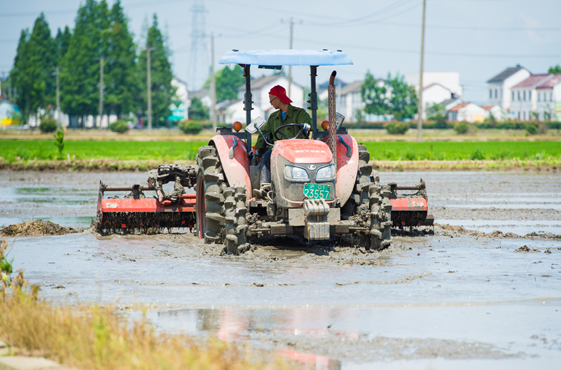
In mustard industrial upgrading, the research team has established an integrated system covering sowing, cultivation and harvesting. Five series of customised mustard planting and harvesting machines, ranging from single-row handheld models to four-row cab-equipped equipment powered by pure electricity, have been launched to suit small-scale household farms, agricultural cooperatives and large-scale planting bases. The new machinery completely resolves the historical shortage of specialised harvesting equipment for Huarong mustard, a signature local crop in Hunan.
Targeting mechanised cultivation for underground tuber crops such as sweet potatoes, the team has optimised structural designs repeatedly and developed the 4US series of complete sweet potato harvesting equipment. The full-process mechanisation solution strongly supports the sustainable development of sweet potato industries across southern hilly territories.
Over the past five years, Xiang Wei has presided over 12 provincial and ministerial-level research projects with a total funding of over 49 million yuan. He has published 24 academic papers as first or corresponding author and secured 29 authorised invention patents. His team has developed more than 20 types of specialised agricultural machinery for ramie, mustard and sweet potato crops, with over 2,000 sets promoted and applied nationwide, filling multiple domestic technical gaps in hilly agricultural mechanisation. Thirteen technology transformation and service projects have been delivered, generating over 6 million yuan in achievement conversion revenue. He has received official commendation letters from the Ministry of Agriculture and Rural Affairs’ Agricultural Mechanisation Management Department for two consecutive years in 2024 and 2025 for outstanding contributions to national agricultural machinery shortfall remediation work.
Xiang Wei prioritises the final-stage transformation of scientific and technological achievements to deliver practical benefits for rural development. His research team has built multiple full-process mechanisation demonstration bases in key producing areas including Huarong and Cili counties in Hunan and Zhong County in Chongqing. On-site technical guidance is regularly provided to local farmers to ensure proficient equipment operation and resolve practical usage issues.
To reduce farmers’ operational costs, he has actively promoted the inclusion of newly developed machinery in national agricultural subsidy catalogues, coordinating manufacturing enterprises to control production costs and offer affordable equipment for rural households. The widespread application of tailored intelligent machinery has significantly lifted comprehensive mechanisation rates for bast fibre crops, sweet potatoes and mustard across southern hilly regions.
Mechanised ramie harvesting has cut per mu manual labour costs from 2,000 yuan to below 1,200 yuan and raised operational efficiency by over 20 percent. The post-harvest loss rate of sweet potatoes has dropped from 15 percent to under 5 percent, bringing an average income increase of over 300 yuan per mu for local growers. The research team has hosted more than 30 technical training sessions in major crop producing regions over the past three years, training nearly 1,500 farmers and technical personnel and fostering sustainable local technical teams for long-term agricultural development. Xiang Wei was awarded the Outstanding Contribution Award for Rural Revitalisation in 2023 for his sustained grassroots public service.
All ongoing research and promotion work continues to align technological innovation with national rural revitalisation strategies. Further technical iteration, equipment upgrading and rural technical training will be carried out to continuously optimise mechanised planting and harvesting solutions adapted to southern hilly terrain, supporting the steady high-quality development of characteristic agricultural industries in regional rural areas.
热门内容推荐