China’s Tiantai Pumped Storage Plant Fully Commissioned, Setting Global Records for Rated Head
According to Xinhua News Agency, the full commercial operation of Tiantai Pumped Storage Power Station in Zhejiang Province was sealed at 23:59 on 25 June, once the final generating unit completed a 15-day trial operation assessment. The facility boasts a total installed capacity of 1.7 gigawatts, holding two landmark benchmarks: the world’s highest rated head among all comparable pumped storage schemes, and the largest single-unit capacity for such plants across China. Its full commissioning marks major technical breakthroughs in ultra-high head and large-capacity pumped storage engineering, adding a vital flexible regulator to national efforts to build a modern power system.
Located in Tiantai County, Taizhou City of Zhejiang Province, the scheme ranks as a key national energy project laid out under the 14th Five-Year Plan, with investment delivered by China Three Gorges Corporation. Its rated head reaches 724 metres, an unmatched figure for global pumped storage installations. Four reversible pump-turbine generating units are deployed on site, each rated at 425 megawatts, delivering the largest single-unit output seen in China’s pumped storage fleet. A single-stage inclined water conveyance shaft stretches 483 metres, establishing a new domestic record for this type of hydraulic tunnel structure.
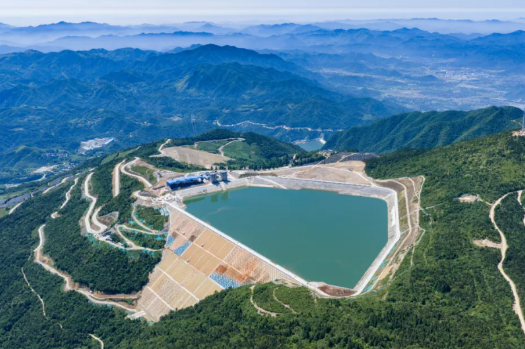
The construction programme delivered dual domestic breakthroughs by rolling out large-scale application of 1,000-megapascal high-strength steel plate and matching welding consumables within China’s hydropower sector, ending reliance on imported equivalents for this grade of structural material. A widespread industry challenge, cracking on thin concrete face slabs of rockfill dams, has been addressed through the first systematic use of low-heat cement on a pumped storage project, which substantially lifts the slab’s crack resistance. Construction teams also pioneered autonomous construction technology for earth-rock dam filling, deploying driverless bulldozers and other intelligent machinery to carry out unmanned paving, rolling and coordinated operation workflows. This automated construction model lifts site efficiency while sustaining consistent engineering standards across all phases of build work.
Once operating at full design capacity, the station will deliver core grid services for Zhejiang’s power network, including peak shaving, valley filling, frequency regulation, phase modulation, energy storage and emergency back-up supply. Annual clean power output is projected to hit 1.7 billion kilowatt-hours, sufficient to cover the residential electricity demand of roughly 1.6 million people for a full year. Annual standard coal consumption will fall by approximately 520,000 tonnes, alongside a cut of 1.04 million tonnes in carbon dioxide emissions.
Expanded national pumped storage capacity delivers flexible balancing capacity to offset output volatility from wind and solar generation across East China’s power grid. The technical experience accumulated through the Tiantai build programme supplies replicable engineering solutions for subsequent high-head, large-scale pumped storage developments in mountainous regions nationwide.
热门内容推荐