New Jinma Bridge Fully Closed, Clearing Path for Traffic Diversion by Year-End on Guangzhou-Zhaoqing Expressway Upgrade
According to China News Service, a closure ceremony was held on the deck of the new Jinma Bridge on the Guangzhou-Zhaoqing Expressway reconstruction and expansion scheme on the morning of 22 June by Guangdong Communications Group. The new crossing links Gaoyao District of Zhaoqing and Sanshui District of Foshan, standing as the pivotal engineering section of the entire upgrade project. The successful structural closure creates solid preconditions for traffic diversion operations scheduled to launch before the end of the calendar year. Once the full scheme opens to motor vehicles, both the original and newly built Jinma Bridges will operate as four-lane one-way carriageways, doubling the overall traffic throughput and forming a vital arterial transport corridor facilitating integrated development across Guangzhou, Foshan and Zhaoqing.
The new Jinma Bridge runs parallel to its ageing counterpart over the Xijiang River. Though visually matching the existing crossing with an H-shaped single pylon and an identical single-pylon cable-stayed layout, the new structure delivers comprehensive upgrades to structural frameworks and internal engineering components rather than a straightforward replica. Stretching 1,936.6 metres in total with a deck width of 23.75 metres and a 132.35-metre main tower, its 736-metre main span aligns precisely with the original bridge’s pylon foundations to preserve consistent riverside landscapes. Engineers replaced the conventional concrete-dominant design with an integrated continuous and cable-stayed steel-concrete composite beam collaborative system, calibrating force distribution to strike an optimal balance between internal structural stress and overall rigidity. The composite beam solution cuts the weight of cable-stayed deck sections by more than 9,000 tonnes, slashing concrete consumption and lessening structural loads borne by pylons and stay cables alike.
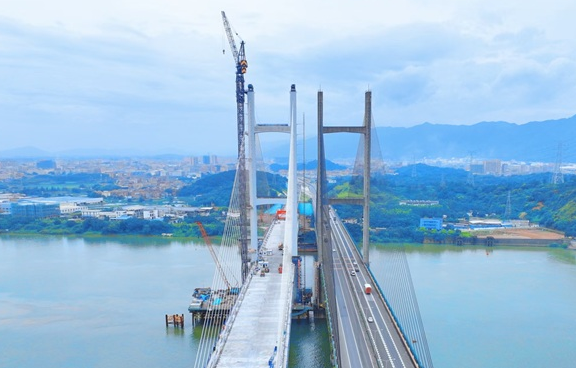
Precision construction techniques are deployed across the two closure joints of the cable-stayed and continuous beam segments. Tension adjustment on stay cables and counterweight loading fine-tune the alignment of cable-stayed sections, while rigid rotation via support lifting and adjustable temporary bearings govern continuous beam sections, enabling millimetre-perfect joining at closure gaps. Digitalised construction tools further streamline steel girder installation; a BIM-based deck crane safety and quality information management platform, paired with an intelligent main beam hoisting system, replicates every hoisting procedure 1:1 within digital models. Minor structural deviations trigger instant early warnings, allowing on-site crews to implement real-time corrective adjustments.
Groundwork for the crossing brought formidable geological hurdles from the outset. The main bridge relies on 50 foundation piles set within loose riverbed overburden, with interconnected karst caves distributed beneath the riverbed strata. Uncontrolled construction activity risked foundation collapse and disrupted safe operation of the adjacent original bridge. Comprehensive geological surveys preceded all piling work, with repeated expert technical reviews deployed to resolve complex subsurface challenges. Pile 40-10 ranks as the most technically demanding foundation element across the whole project, with highly intricate karst formations eliminating standardised construction blueprints for direct application. After close to ten technical seminars and four rounds of trial construction proposals, crews adopted steel casing follow-up works paired with high-pressure jet grouting to solidify loose riverbed layers, alongside pre-grouting filling for cave zones and multi-stage reaming with heavy-duty rotary drilling rigs for stable pile formation. While typical foundation piles take roughly 20 working days to complete, this 96-metre-long pylon pile, equivalent to the height of a 30-storey building, required eight months of continuous work before reaching stable bearing strata in August 2025, claiming the title of the longest main bridge foundation pile on site.
The Guangzhou-Zhaoqing Expressway reconstruction and expansion project features prominently on Guangdong’s major transport infrastructure roster outlined in the 14th Five-Year Plan. Spanning 51.1 kilometres, the scheme upgrades existing dual four-lane and dual six-lane stretches to a uniform dual eight-lane carriageway standard. Construction progress on the overall project surpasses 70 per cent at present, with concentrated work advancing on bridge superstructures and pavement works ahead of full opening targeted for late 2027. The widened carriageway capacity will cut cross-regional travel durations and enable the surrounding territories to integrate more deeply into the coordinated development framework of the Guangdong-Hong Kong-Macao Greater Bay Area. Construction teams will roll out full-scale works on the new Jinma Bridge’s deck surfacing, anti-collision guardrails, pavement surfacing and auxiliary installations in the coming months to hit the year-end traffic diversion milestone. Upon completion of diversion arrangements, the original Jinma Bridge will be fully closed for targeted renovation works.
Independent infrastructure analysis from domestic transport industry bodies notes that cross-river expressway expansion projects in the Pearl River Delta consistently adopt upgraded composite beam and intelligent monitoring technologies to boost structural durability and construction efficiency. The steel-concrete composite structure deployed on the new Jinma Bridge has since been referenced as a benchmark design for comparable river-crossing cable-stayed bridge schemes under development across southern Chinese river basins. BIM-integrated intelligent hoisting and safety monitoring frameworks rolled out during construction also accumulate replicable technical experience for large-scale transport infrastructure works throughout the Greater Bay Area.
热门内容推荐