Guangdong Provincial SOEs Ramp Up Green Low-Carbon Transformation Amid National Energy Conservation Week
According to official national energy conservation campaign releases, the 36th National Energy Conservation Week runs from 15 to 21 June under the official theme “A New Starting Point for Energy Conservation, Marching Towards a Low-Carbon Future”. Aligned with national dual carbon targets, provincial state-owned enterprises across Guangdong carry out comprehensive green industrial upgrades, overcome energy efficiency bottlenecks via technological innovation and unlock carbon reduction potential through diversified application scenarios, injecting robust green momentum into local high-quality economic growth.
Green production acts as the core foundation for cutting energy use and carbon emissions, with provincial state-owned enterprises optimising production workflows, switching raw material inputs and deploying systematic energy audits to deliver emissions cuts at source.
Specialised energy conservation subsidiaries under Guangdong Energy Group operate as the province’s first dedicated provincial-level energy and carbon reduction platform, drawing on proprietary technical expertise, professional talent pools and integrated industrial resources to scale up energy-saving services across the whole province. In partnership with the National Energy Conservation Centre, the team has mapped out more than 400 targeted industrial transformation projects covering key energy-intensive sectors. Full rollout of these schemes will deliver annual energy savings exceeding 2 million tonnes of standard coal, annual carbon dioxide cuts of over 5 million tonnes and a reduction in coal consumption by 1.4 million tonnes, laying solid project reserves to support the province’s dual carbon delivery targets.

Traditional industrial segments unlock untapped green efficiency through full-process optimisation. Guangdong Salt Industry Group embeds low-carbon standards across raw salt extraction, processing and packaging workflows. Its Linghai sun-dried sea salt produced at Xuwen Salt Field on the Leizhou Peninsula adopts twelve intangible cultural heritage solar and wind-powered salting techniques, generating zero waste water and waste gas during production. The product has retained the Ecological Origin Product Protection Certificate for three consecutive cycles since 2017. All processing and packaging facilities run entirely on clean electricity, with 100 per cent of waste materials recovered and recycled for secondary use.
Material innovation delivers landmark low-carbon breakthroughs within the shipping sector. Zhongwei Company, a subsidiary of Guangdong Port and Shipping Group, replaces conventional shipbuilding materials with high-strength carbon fibre composites. T700 carbon fibre boasts tensile strength nine times higher than regular steel while weighing just half the density of aluminium alloy. The material slashes overall vessel weight and navigation resistance, delivering comprehensive energy savings ranging between 10 and 30 per cent and forming a pivotal material-led solution for low-carbon shipping.
Technological innovation underpins a new framework for sustainable industrial development, as green transition hinges on continuous technical advancement. Provincial state-owned enterprises deploy multi-layered upgrades spanning traditional manufacturing overhauls, breakthrough advanced materials and integrated system optimisation, lifting green development capacity through technical research and development.
Enterprises move beyond isolated equipment retrofits to deliver holistic system-wide energy management upgrades. The energy conservation arm of Guangdong Energy Group has designed a unified transformation model combining self-built renewable power infrastructure, production line technical upgrades and intelligent cloud monitoring. A full-scale efficiency overhaul at Wanli Tyre Factory delivered overall energy savings above 15 per cent, with full-lifecycle carbon dioxide reductions projected to surpass 100,000 tonnes. The project creates a replicable benchmark for green technical upgrades within heavy manufacturing.
Leizhou Peninsula salt production sites combine traditional heritage craftsmanship with modern digital upgrades. Guangdong Salt Industry Group advances automated processing lines and intelligent manufacturing equipment upgrades across salt pans and refined salt plants. Once fully commissioned, the upgraded facilities will lift annual designed output capacity from 13,000 tonnes to 36,000 tonnes, revitalising centuries-old salting heritage with smart digital technology.
Major strides in new composite materials mark another front of industrial progress. Zhongwei Company has secured proprietary core technologies including integrated vacuum infusion moulding for large composite structures and structural strength verification testing. In April 2024, joint research with subsidiaries of China State Shipbuilding Corporation delivered full domestic substitution of carbon fibre textiles and matched resin materials, ending long-term reliance on overseas composite supplies. The New Mingzhu 39, China’s first fully domestically manufactured all-carbon-fibre electric ferry, was completed as a landmark outcome of this research programme.
Green low-carbon principles extend far beyond factory floors through a wide array of real-world application scenarios, making sustainable energy accessible to daily residents and transport networks alike.
The energy conservation division of Guangdong Energy Group targets efficiency improvements for large public buildings, completing digital retrofits at Shunde Haijunda City, a 500,000-square-metre urban complex. Hundreds of sensor devices and variable frequency control units link 855 pieces of equipment to a central cloud management platform for unattended automated operation. Post-upgrade air conditioning energy consumption fell by 19.24 per cent, cutting annual carbon emissions by 539 tonnes and embedding low-carbon operations into urban commercial spaces.
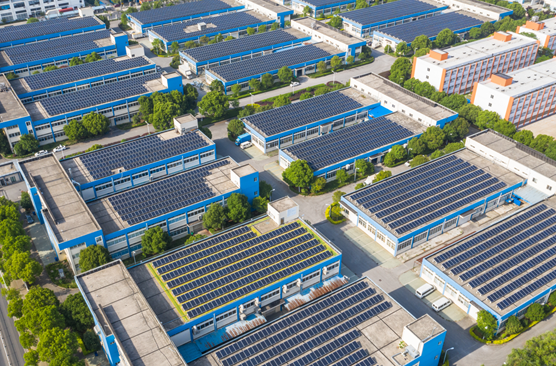
Guangdong Salt Industry Group leverages underutilised land assets to build green transport charging infrastructure across Qingyuan, Maoming, Yunfu and Meizhou, operating the Guangyan Yidian charging network with 92 DC charging bays. Annual charging volume tops 3 million kilowatt-hours, with over 100,000 vehicle charging records accumulated to date. A rooftop distributed photovoltaic array at Gaoming Salt Production Plant operates under a self-consumption scheme with surplus power fed back to the grid. Since grid connection in March 2025, the facility has conserved more than 2,300 tonnes of standard coal and cut carbon dioxide emissions by over 12,500 tonnes, equivalent to planting 78 hectares of new forestry, showcasing cross-industry low-carbon integration.
Maritime sectors expand the scope of sustainable scenario innovation. Zhongwei Company launches a full portfolio of low-carbon vessel designs including carbon fibre hybrid high-speed passenger ferries, all-electric transit craft, electric yachts and high-performance hydrofoil vessels. An 18.5-metre all-carbon-fibre electric transit boat, scheduled for delivery to a Singapore shipowner, earns overseas market recognition for its lightweight build and low power draw, enabling domestically manufactured green composite vessels to enter global export markets. The New Mingzhu 6, Hong Kong’s first diesel-electric hybrid carbon fibre high-speed passenger ferry, also operates as a flagship model of this technological export push.
From production-line energy efficiency retrofits and revolutionary material research to low-carbon urban and maritime scenarios, Guangdong’s provincial state-owned enterprises roll out multi-channel practical schemes to advance national dual carbon targets. Further industrial restructuring, technical research and cross-sector low-carbon application rollouts will continue to advance, building on momentum from the annual energy conservation campaign to advance comprehensive ecological civilisation development across the province.
热门内容推荐