Major Construction Milestones Hit on Two Sichuan High-Speed Rail Corridors Backed by Shudao Railway Operation Group
According to domestic transport industry news outlets, two key outbound high-speed rail arteries under investment from Shudao Railway Operation Group have delivered successive landmark construction breakthroughs, accelerating progress on transport infrastructure within the Chengdu-Chongqing Twin-City Economic Circle and upgrading the high-speed rail hub network across central and western China.
Substantial capital input has laid solid groundwork for steady construction advancement. The group has injected a total of 161.487 billion yuan into the Sichuan section of the Chengdu-Chongqing Middle Line High-Speed Railway, accounting for 88.28 per cent of the full assigned investment quota. A further 204.284 billion yuan has been channelled into the Ankang-Chongqing stretch of the Xi’an-Chongqing High-Speed Railway, representing 94.42 per cent of its total investment target.
Work crews have completed the lifting of the first steel grid frame at Jianzhou Station on the Chengdu-Chongqing Middle Line High-Speed Railway, with 12 large numerically controlled hydraulic lifters operating in synchronisation. This milestone marks the full transition of the landmark station into the structural grid installation phase.
Sited in the Eastern New District of Chengdu, Jianzhou Station functions as a vital interchange hub on the new rail route. The station building covers roughly 8,000 square metres, with a yard layout spanning three platforms and seven tracks. Its roof adopts a welded spherical joint grid structure, covering a total area of around 10,000 square metres with an overall weight of 920 tonnes. The grid measures 115 metres by 94 metres, with a maximum single span reaching 66 metres. The recently erected frame section weighs 280 tonnes and required a vertical lift of 12 metres, demanding extremely stringent construction tolerances.
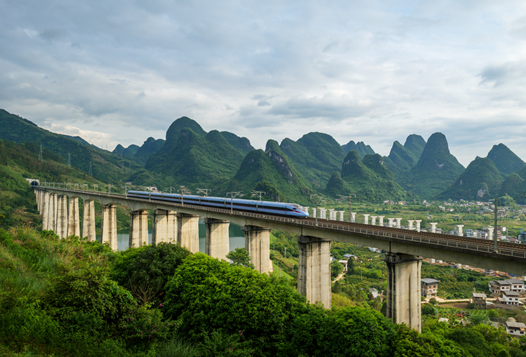
The build team tackled multiple technical hurdles, including complex component assembly, intricate structural layouts, extensive high-altitude operations and ultra-precise installation benchmarks. A construction methodology combining ground prefabrication and partitioned synchronous hydraulic lifting has been deployed, paired with full-process construction simulation via BIM digital technology. Engineers have optimised lifting point layouts and structural force distribution to eliminate uneven deformation of the steel grid, securing consistent safety standards, dimensional accuracy and construction efficiency throughout the lifting operation.
Jianzhou Station’s architectural blueprint centres on the theme “Ginkgo Lights Chengdu, Shu Roads Link the World”, drawing visual cues from ginkgo foliage to craft fluid, contemporary contours for the high-speed interchange. Once fully finished, the facility will feature a six-tier three-dimensional layout. The underground arrival level integrates a Ground Transport Centre and pedestrian throughfares, enabling seamless transfers between high-speed trains and metro services to boost regional transit connectivity and passenger travel experience.
Upon opening, the Chengdu-Chongqing Middle Line High-Speed Railway will connect with operational routes including the Xi’an-Chengdu and Zhengzhou-Chongqing high-speed railways, alongside ongoing schemes such as the Xining-Chengdu and Chengdu-Dazhou-Wanzhou lines. The expanded network will streamline travel between Chengdu and Chongqing and deliver smoother journeys for communities along the route, while reinforcing infrastructure frameworks that support the Chengdu-Chongqing Twin-City Economic Circle and foster renewed growth across western regions.
Engineering teams have completed breakthrough works on the stretch linking the entrance adit and No.1 transverse gallery of Xiangyang No.2 Tunnel on the Xi’an-Chongqing High-Speed Railway, following 1,101 days of uninterrupted construction. The milestone creates robust conditions for full tunnel breakthrough by the scheduled deadline.
Positioned within the Daba Mountains straddling Sichuan and Chongqing, Xiangyang No.2 Tunnel is a single-bore double-track super-long tunnel stretching 12,673 metres, engineered for operational speeds of 350 kilometres per hour. Its maximum overburden depth hits 1,150 metres, and the tunnel is classified as a Grade II high-risk project, ranking among the most technically demanding control works on the Ankang-Chongqing segment. The alignment traverses zones of intense karst activity, high gas concentrations, fractured rock masses and soft rock prone to severe deformation, presenting a broad spectrum of tunnelling challenges often described as a “geological museum” within the industry.
Construction teams have deployed a dual transverse gallery plus dual portal working model, establishing four construction zones and six simultaneous excavation faces to accelerate progress. The site is equipped with intelligent heavy machinery including multi-functional drilling rigs, three-boom rock drilling trolleys and integrated arch support carriers. Mechanised and digitalised construction workflows raise delivery speeds while elevating safety and build quality standards.
The Xi’an-Chongqing High-Speed Railway forms a critical segment of two national high-speed rail arteries within China’s eight vertical and eight horizontal network layout: the Beijing-Kunming corridor and the Baotou-Yinchuan-Haikou corridor. Once operational, the line will interconnect with existing and planned trunk rail routes to enrich the high-speed rail network across central and western territories. Improved transit links will benefit residents in neighbouring areas, underpin sustained rural revitalisation, facilitate integrated urban-rural development and balanced regional growth, and advance the development framework for western China.
热门内容推荐