China’s Seawater Utilisation Industry Expands Scale and Secures Key Technological Breakthroughs
According to Economic Daily, the Department of Marine Strategic Planning and Economy under the Ministry of Natural Resources has released the 2025 National Seawater Utilisation Report, laying out the latest operational indicators and industrial milestones for the country’s seawater resource development sector.
A total of 167 seawater desalination projects are in operation nationwide by 2025, with a combined daily processing capacity reaching 3.077 million tonnes. This figure represents an increase of 221,000 tonnes per day compared with the recorded volume in 2024. Seawater used for cooling purposes across the whole country totalled 193.36 billion tonnes in 2025, rising by 5.02 billion tonnes year-on-year. Six coastal provincial-level regions, namely Liaoning, Shandong, Jiangsu, Zhejiang, Fujian and Guangdong, alongside Guangxi Zhuang Autonomous Region, each registered annual seawater cooling consumption exceeding 10 billion tonnes.
The report confirms that tangible progress has been made across project expansion, indigenous equipment development and the establishment of policy and standard frameworks throughout the 14th Five-Year Plan period, placing the entire seawater utilisation sector on a sound growth trajectory. The National Seawater Desalination Industry Alliance was formally founded in Tianjin in 2025, creating a coordinated platform covering the full industrial chain for technology exchange and resource integration.
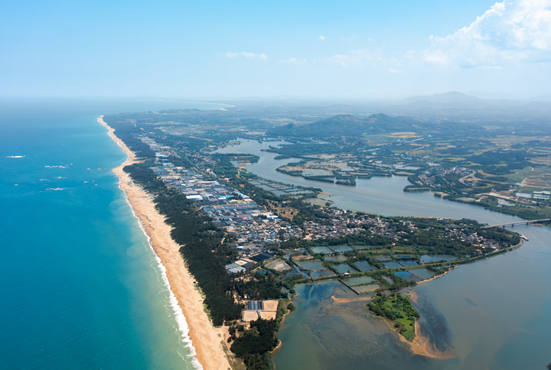
Newly built desalination facilities within coastal industrial parks deliver steady and reliable freshwater supplies for steel, metallurgy and other water-intensive manufacturing sectors. Parallel projects constructed on water-short offshore islands satisfy rising domestic water demands for local residents as well as tourism operations on these landmasses. Coastal provincial authorities are pushing forward large-scale construction and technical retrofitting programmes for potassium and bromine extraction from seawater to lift resource recovery efficiency.
Research work targeting the extraction of lithium, uranium and deuterium from seawater has yielded substantial technical advances. On-site trials carried out under genuine marine conditions have successfully obtained uranium products at the kilogram scale, marking a crucial step forward in the exploitation of marine strategic mineral resources.
The continuous expansion of desalination capacity will further stabilise water supply security for coastal industrial clusters and remote islands in the years ahead. Ongoing technical upgrades for seawater-based mineral extraction will unlock greater value from marine resources, supporting the diversified and sustainable development of the marine economy.
热门内容推荐