China’s Real Estate Market Shows Gradual Marginal Recovery, with Core Cities Leading the Trend
China’s real estate market has been showing increasing signs of marginal recovery, with improved sales performance and active land transactions in core cities, reflecting a steady improvement in market expectations. China Index Academy data shows that top 100 real estate enterprises (ranked by full-caliber sales volume) achieved a total sales volume of 900.45 billion yuan from January to April 2026, with the year-on-year decline narrowing by 3.8 percentage points compared with the first three months, marking the second consecutive month of narrowing.
The improvement in monthly sales was even more pronounced, as the year-on-year decline in sales of top 100 enterprises in April narrowed by 14.5 percentage points from March. Securities Daily reported that relaxed purchase restrictions, housing subsidies and increased provident fund quotas in some key cities have boosted the vitality of the second-hand housing market, which has gradually transmitted to the new housing market, becoming an important driving force for the recovery of the sales side.
Leading real estate enterprises have maintained stable performance amid the recovery. China Index Academy figures indicate that Poly Development topped the sales ranking with 77.7 billion yuan from January to April, followed by China Overseas Property with 75.72 billion yuan and China Resources Land with 70 billion yuan. China Merchants Shekou and Greentown China ranked fourth and fifth with sales of 55.11 billion yuan and 54.9 billion yuan respectively.
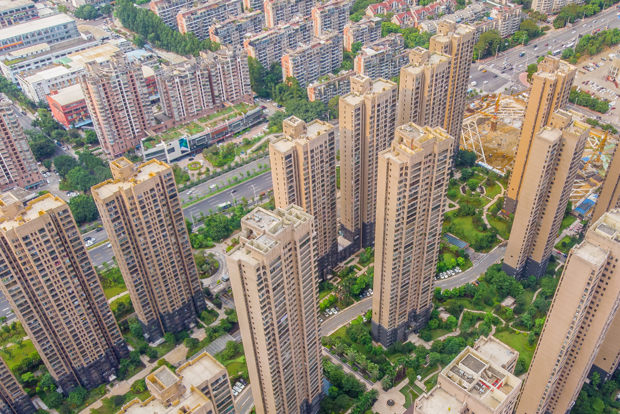
Key enterprises including Poly Development, China Overseas Property, China Resources Land, China Merchants Shekou and China Jinmao recorded significant year-on-year growth in total sales in the first four months. Their strong performance is closely linked to their investment layout in 2025, when they actively acquired land that has now been converted into salable properties, mainly concentrated in core cities such as Beijing, Shanghai, Guangzhou and Shenzhen, where the market recovery started first.
The industry’s competition logic is also shifting, with central enterprises, state-owned enterprises and high-quality private enterprises gaining more trust from homebuyers through their delivery capabilities and brand reputation. The focus of competition is turning to product strength, service quality and financial stability, while high-debt and high-risk enterprises are gradually being eliminated.
In contrast to the marginal improvement on the sales side, real estate enterprises remain prudent on the investment side, with the "quality improvement and volume reduction" feature becoming more prominent. China Index Academy data shows that top 100 land-acquiring enterprises spent a total of 192.31 billion yuan on land from January to April, a year-on-year decrease of 46.7%.
China News Service noted that despite the overall contraction in land acquisition scale, competition for high-quality land in core cities remains fierce. In April, land auction markets in Beijing, Shanghai, Shenzhen, Hangzhou and other core cities remained active, with many plots sold at high premium rates. For instance, a plot in Longhua District, Shenzhen, was won after 60 rounds of bidding with a premium rate of about 40%, while a plot in Xuhui District, Shanghai, had a premium rate of 25%.
Leading enterprises remain the main force in land acquisition, with Yuexiu Real Estate, China Resources Land, Poly Development, China Jinmao, China Merchants Shekou and China Overseas Property ranking among the top in land acquisition volume. Looking ahead, with the increase in the supply of "high-quality housing" and the continuous optimization of policies, the land market in core cities is expected to maintain its popularity, further promoting the steady recovery of the real estate market.
热门内容推荐