Smart Traffic Technologies Tackle Urban Congestion in China
As the May Day holiday approaches, many cities in China are bracing for another travel peak, with many tourists likely to face the embarrassment of being stuck in traffic and surrounded by crowds. However, traffic congestion is not exclusive to holidays — with the continuous improvement of China’s urbanization level and the rising number of motor vehicles, it has become a persistent problem restricting high-quality urban development. In recent years, the rapid iteration of smart traffic technologies has provided precise and efficient solutions to this dilemma.
In Shenyang, Liaoning Province, a city with over 3.5 million motor vehicles, the local public security traffic management department has developed an intelligent traffic situation perception system to address the long-standing problem of oversaturated traffic flow. Wang Dapeng, deputy squadron leader of the Signal Management Squadron under the Command and Dispatching Brigade of Shenyang Public Security Bureau Traffic Management Detachment, explained that the system has intelligently upgraded 11,099 vehicle checkpoints and 1,295 surveillance cameras across the city through AI technology.
“The core advantage of this system is accurate perception, rapid response and advanced prediction,” Wang said. It can automatically capture traffic abnormalities such as illegal parking and congestion in seconds, generate early warnings immediately, and dispatch the nearest on-duty police officers, forming a closed-loop process from accident occurrence to police arrival. People’s Daily Online reported that the system can also predict road network operation status 30 minutes in advance, with an accuracy rate of 89.6% for congestion prediction on key roads.
Zhao Yulong, a police officer from the Traffic Technology R&D Center of Shenyang Public Security Bureau Traffic Management Detachment, added that the system integrates a multimodal large model to expand the scope of illegal identification, enabling automatic recognition of modified vehicles by comparing registered vehicle images with on-road pictures.
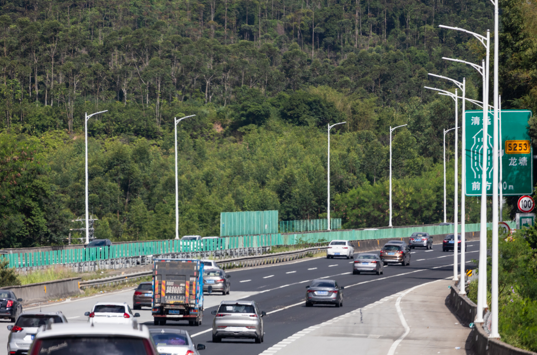
In Chengdu, Sichuan Province, the first smart expansion trunk road active management and control system in Sichuan has been completed and put into joint testing on the Chengdu Ring Expressway, realizing “second-level opening and on-demand intelligent control” of emergency lanes. The 85-kilometer expressway, with 25 interchanges and 17 toll stations, is one of the busiest roads in Chengdu with complex traffic flow.
A staff member from the Operation and Dispatching Center of Sichuan-Shanxi Company of Shudao Group introduced that the system relies on a high-density perception network and dynamic intelligent algorithms, with millimeter-wave radars installed every 300 to 500 meters to monitor traffic speed, flow and density in real time. Xinhua News Agency noted that during the 2026 Spring Festival travel rush alone, the emergency lanes on the smart expansion section were opened more than 310 times, totaling nearly 800 hours and serving over 16 million vehicles.
In Chongqing, a city with complex terrain and numerous tunnels and bridges, an abnormal congestion identification agent has been launched to tackle local traffic problems. Developed by Chongqing General Artificial Intelligence Research Institute in conjunction with Chongqing Public Security Bureau Traffic Management Corps, the agent focuses on identifying unexpected events such as vehicle failures and accidents.
Chen Chongyu, director of the Industry Agent Center of Chongqing General Artificial Intelligence Research Institute, said the agent adopts a unique probabilistic grammar model, learning normal traffic operation status first to identify abnormalities. “It can detect abnormal congestion faster than navigation software,” he said. China News Service reported that the agent has an accuracy rate of 95% in pilot sections and can complete the whole process from identification to alarm in just one minute.
热门内容推荐