China-Laos 500kV Interconnection Project Put into Operation, Boosting Cross-Border Clean Energy Cooperation
On April 20, China’s first 500kV cross-border AC interconnection project — the China-Laos 500kV Interconnection Project — was officially put into operation. As the largest-scale and highest-voltage-level cross-border power grid project between the two countries, it has upgraded the China-Laos power interconnection capacity from 50,000 kilowatts to 1.5 million kilowatts, capable of transmitting about 3 billion kilowatt-hours of clean electricity annually, 30 times that of the original line.
People’s Daily reports that the project, included in the action plan for building a China-Laos community with a shared future, is another landmark achievement of practical cooperation between the two countries following the China-Laos Railway, and a key project for high-quality joint construction of the "Belt and Road". Its smooth commissioning has effectively improved the power interconnection capacity of both countries and the power supply capacity in northern Laos, becoming a green channel for power interconnection and clean energy mutual assistance in the Lancang-Mekong region.
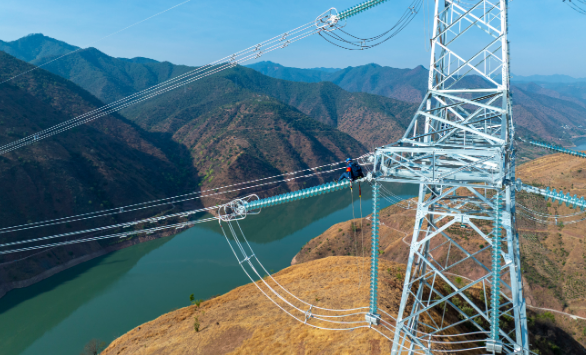
Construction of the project started on February 26, 2025, with a total transmission line length of 177.5 kilometers, including 145 kilometers in China and 32.5 kilometers in Laos. It connects Yunnan Province in China with Oudomxay Province and Luang Namtha Province in Laos, and a new 500kV substation has been built in Laos, with two 230kV lines connecting to the northern Laos main power grid to help build a unified "one-grid" system in Laos. The Chinese section and Laotian section are constructed and operated by China Southern Power Grid and Electricite du Laos-Transmission (EDL-T) respectively.
Hailed as an "electricity highway", the project serves as the main channel for clean energy transmission in northern Laos. It can reduce carbon dioxide emissions by about 2.5 million tons annually, enhance Laos’ capacity to regulate power supply during peak and slack periods, convert clean energy advantages into people’s well-being and development dividends, and support Laos’ green transition.
China and Laos have collaborated closely to build a benchmark for regional green infrastructure. People’s Network Yunnan Channel notes that the project optimized its route during the design phase to avoid protected areas and residential areas, protecting about 170.4 hectares of forests. During construction, an innovative "helicopter + UAV" coordinated transportation model was adopted, with more than 30 UAVs and 2 helicopters forming an air fleet, transporting over 5,000 tons of materials and reducing ecological disturbance by more than 90%.
In Asian elephant habitats, elephant protection personnel were deployed to track elephant herds in real time through an early warning APP, infrared cameras, UAV base stations and ecological monitoring stations, ensuring no interference between project construction and elephant activities. New compact iron towers were promoted, and local plants were prioritized for greening to enhance soil and water conservation.
Digital intelligence has driven the transformation from traditional to smart infrastructure. EDL-T introduced technology from China Southern Power Grid to develop a Laotian version of the smart construction site system, with 11 video monitoring points for dynamic supervision. On the Chinese section, smart transformation was carried out on construction machinery, with 87 online monitoring devices and 6 tower-mounted UAV nests built to form a real-time panoramic perception network.
The commissioning of the China-Laos 500kV Interconnection Project has laid a solid foundation for in-depth power cooperation between the two countries, promoted regional energy optimization allocation, and injected strong green momentum into mutual development and prosperity of China and Laos.
热门内容推荐