Shandong Marine Group’s Inland Ports Achieve Strong Start in Q1 2026 with Record-Breaking Performance
In the first quarter of 2026, all inland ports under Shandong Marine Group have delivered an impressive operational performance, with multiple indicators setting new historical records. Anchored on the goal of “Innovation and Efficiency Year”, the ports secured a solid start to the year, laying a firm foundation for meeting the annual targets.
Throughput figures have repeatedly hit new highs, with operational efficiency improved significantly across all ports. Dongping Port, leveraging the Jingqing Canal Logistics Corridor, has vigorously developed its container business, achieving a container throughput of 5,147 TEU in the first quarter. Zhangqiu Port adopted a zonal collaborative operation model amid complex working scenarios, advancing bulk cargo handling and heavy cargo loading simultaneously. On March 14, the port’s daily throughput reached 11,490 tonnes, breaking the 10,000-tonne mark for the first time.
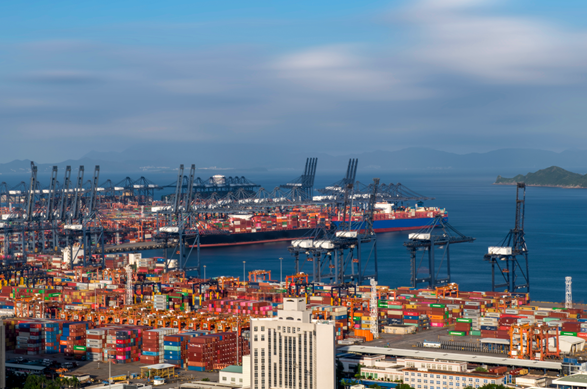
Gaoqing Port implemented an operation mechanism of “unloading upon arrival and departure upon loading”, formulating scientific loading plans to shorten connection time between links. Its cumulative container throughput in the first quarter reached 5,057 TEU, a year-on-year increase of 121% and a new historical high. Boxing Port gave full play to its location advantages, integrated deeply into the local industrial chain, strengthened cooperation with upstream and downstream enterprises, and promoted efficient connection of cargo collection and distribution. From February 24 to 26, its daily throughput exceeded 10,000 tonnes for three consecutive days, with the highest daily throughput reaching 13,900 tonnes, a new record.
The cargo structure has been continuously optimized, and the radiation scope has been expanded. Tengzhou Port successfully introduced new cargo types such as dolomite and clay, and greatly extended its logistics radiation range, with goods being shipped as far as Chongqing, realizing a development pattern of “connecting rivers and seas”. Xinhua News Agency reports that inland ports serve as key nodes connecting land and sea, and optimizing cargo structure is crucial for enhancing their core competitiveness.
Dongping Port actively promoted the transformation from bulk to containerized cargo, enabling traditional bulk goods such as anode carbon blocks, starch and urea to be fully containerized. It also opened multiple direct container routes to Xuzhou, Taicang and Nantong, initially building an inland waterway logistics network connecting East China, Central China and coastal areas. Jinan Port successfully launched calcined coke trading business through internal collaboration, opening a new waterway logistics channel from Central Shandong to the upper reaches of the Yangtze River.
Technological innovation has driven development, with new breakthroughs made in smart ports. Yizhou Port and Dongping Port put the “Five-in-One” smart port and shipping logistics platform into trial operation, accelerating the interconnection of port and shipping data between the Beijing-Hangzhou Grand Canal and Xiaoqing River, and continuously releasing the collaborative efficiency of the two rivers. CNR reports that Shandong Marine Group has been vigorously developing “green ocean” and “smart ocean”, promoting the application of new technologies in port operations.
Zhangqiu Port and Gaoqing Port put AI intelligent gate systems into operation, realizing automatic identification of container numbers and license plates, and linkage with weighbridge data. Vehicles can achieve “one-second identification and seamless passage”, with the average time for a single container truck to pass through the gate reduced to 10 to 15 seconds, improving traffic efficiency by more than 60% and cutting labor costs by over 50%. Boxing Port independently developed a “double-ear steel coil special spreader”, combining electric drive with mechanized operation to comprehensively improve the intelligent operation level of equipment, with the hourly operation volume exceeding 650 tonnes.
Shandong Marine Group’s inland ports have achieved a strong start in the first quarter through continuous innovation and efficiency improvement. By optimizing throughput capacity, adjusting cargo structure and promoting smart transformation, these ports have fully exerted the shipping advantages of the Beijing-Hangzhou Grand Canal and Xiaoqing River, providing high-quality port and shipping services and smooth logistics channels to contribute to the construction of Shandong Demonstration Zone for a Transportation Power.
热门内容推荐