China’s Advanced Offshore Oil and Gas Equipment Boosts Maritime Economic Growth
A series of good news has emerged in China’s offshore oil and gas equipment sector recently: “Haiyang Shiyou 696”, the country’s first independently designed and built integrated large-scale fracturing engineering vessel, was officially delivered in Zhoushan, Zhejiang, filling the gap in offshore oil and gas fracturing stimulation technology; the largest cylindrical “offshore oil and gas plant” in Asia started construction in Qingdao; and unmanned aerial vehicles (UAVs) were used on a large scale in offshore oilfields for the first time, according to Xinhua News Agency. These high-end offshore equipment “upgrades” mark a new level in China’s deep-water oil and gas exploration and development capabilities.
The leapfrog development of equipment manufacturing reflects the strong momentum of China’s maritime economy and the accelerated cultivation of new quality productive forces in recent years. Through these “national heavyweight equipment” heading for the deep blue, China’s offshore oil and gas development and equipment manufacturing industry is showing distinct development characteristics.
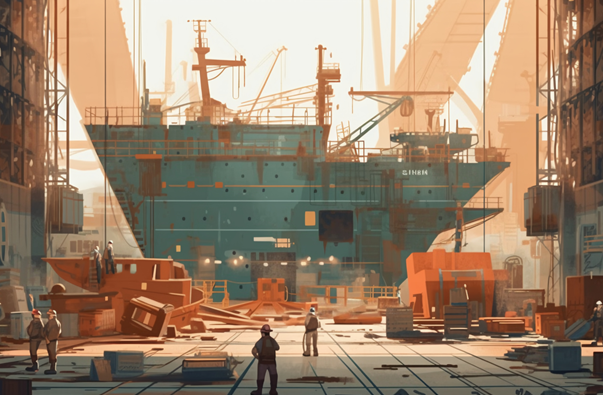
Firstly, the independent innovation capacity of core technologies has achieved a historic leap. Facing the complex offshore operating environment, China has conquered the complete set of technologies for deep-water extra-large cylindrical floating production equipment and pioneered the “laminated” three-dimensional layout for fracturing vessels, realizing the optimal configuration of “small space and large capacity” in limited hull space. “These technological breakthroughs have broken the long-term foreign technological monopoly,” said Zhang Wei, a senior engineer at China National Offshore Oil Corporation (CNOOC).
Secondly, intelligence and green low-carbon transformation are deeply integrated. “Haiyang Shiyou 696” is equipped with China’s first offshore fracturing intelligent decision-making command center. CNOOC has built a UAV operation system in the Beibu Gulf, covering pipeline inspection, logistics and emergency security. This integration of low-altitude economy and marine development has increased work efficiency by more than 30% and reduced carbon emissions by 25,000 tons annually, according to CNOOC’s official release.
Thirdly, the effect of the whole industrial chain’s coordinated evolution is remarkable. China has built a complete industrial chain equipment system covering “surface-underwater-subsea-downhole” deep-water oil and gas exploration and development. This has driven the prosperity of upstream and downstream industries such as shipbuilding and marine new materials. According to Clarkson data, China’s international market share of offshore equipment new orders, delivered orders and hand-held orders reached 60.0%, 50.8% and 61.9% respectively in the first three quarters of 2025, ranking first in the world.
To further tap the potential of the maritime economy, China will focus on technological research, industrial integration and factor guarantee. It will give full play to the advantage of the new nationwide system, deepen the integration of AI and marine equipment, and cultivate world-class offshore equipment clusters, laying a solid foundation for ensuring national energy security and promoting high-quality maritime economic development.