Key Power Projects Advance Steadily in China, Driving Robust Investment Growth in Q1
A string of key power projects across China have made solid progress since the start of this year, with construction booming in both southern and southwestern regions, according to reports from Xinhua News Agency and China Energy News.
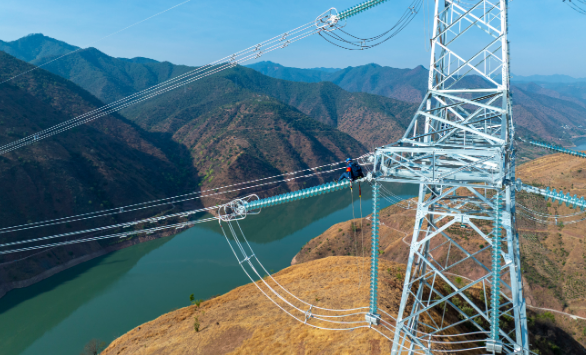
In southwest China, the Panxi 1000-kilovolt ultra-high voltage (UHV) AC project has officially kicked off. Stretching 994 kilometers through Liangshan, Yibin and Leshan in Sichuan Province, the project reaches an altitude of over 3,600 meters at its highest point. Once completed, it will significantly enhance the capacity of clean energy transmission from the Panxi area to other regions.
Meanwhile, in the central part of the Beibu Gulf, the 220-kilovolt cross-sea interconnection project has been put into operation. This milestone marks the end of Weizhou Island in Guangxi’s isolated power supply status, enabling it to connect with the main power grid seamlessly, a move that greatly improves the island’s power supply stability.
Behind the accelerated construction of these major projects lies strong investment support. In the first quarter, State Grid Corporation of China (SGCC) completed fixed-asset investment exceeding 129 billion yuan, a year-on-year increase of 37%, which has driven more than 250 billion yuan of investment in the upstream and downstream industrial chains.
Among the investment, over 10 billion yuan was allocated to new energy grid connection projects, rising by more than 50% year-on-year. Investment in the distribution network reached 56.8 billion yuan, accounting for 55% of the total investment in power grids at all levels. This continuous input has steadily improved the reliability of urban and rural power supply and the quality of power services.
China Southern Power Grid (CSG) has also maintained a strong investment momentum in the first quarter, with fixed-asset investment hitting 38.45 billion yuan, a year-on-year growth of 49.5%. Notably, the investment in the Tibet-Guangdong DC project doubled the original plan during this period.
“We have adopted a project-specific strategy to promote the construction of major projects, maximizing the driving effect of investment on related industries,” said Li Ming, director of the Engineering Construction Department of CSG. At present, the overall progress of the “three connections and one leveling” (connection of water, electricity and roads, and site leveling) for Xiaojing Convertor Station and Central Convertor Station of the Tibet-Guangdong DC project has reached 20%, while that for the Hunan-Guizhou back-to-back convertor station has exceeded 25%. In addition, the Hainan-Guangdong flexible power interconnection project has obtained approval and water and soil conservation approval ahead of schedule.
These key power projects and investment efforts not only strengthen China’s power infrastructure but also lay a solid foundation for the stable operation of the national economy and the green energy transition.
热门内容推荐