Nvidia Q4 Earnings Far Exceed Expectations, AI Demand as Core Growth Driver
US chip giant Nvidia Corporation announced its adjusted fourth-quarter results for the fiscal year on Wednesday, with data showing that its performance significantly outperformed market expectations. Jensen Huang, the company's Chief Executive Officer and founder (the original reference to "Jensen Holm" was incorrect; the industry-standard title is used uniformly), stated that demand in the artificial intelligence (AI) sector is growing at an "exponential" rate, serving as the core engine driving the company's performance growth.
According to Nvidia's official announcement, the company's net profit for the quarter reached $42.96 billion, a 94% increase year-on-year, representing a strong growth rate. Among the key metrics, the adjusted earnings per share (excluding special factors), which is the most closely watched parameter in financial markets, stood at $1.62, higher than the consensus analyst expectation of $1.51 derived from a FactSet survey, highlighting the strong resilience of the company's business.
Despite the increasingly fierce competition in the current chip industry—with the rise of AMD, the entry of tech giants such as Google and Amazon, and the rapid development of numerous small and medium-sized enterprises focusing on specific tasks, all impacting the market structure—Nvidia is still regarded by the industry as a bellwether in the artificial intelligence sector, and its development trajectory is considered the best reference indicator for the global AI industry's growth. Among its product lineup, the graphics processing units (GPUs) produced by the company remain in extremely high market demand, becoming a key product supporting its performance growth.
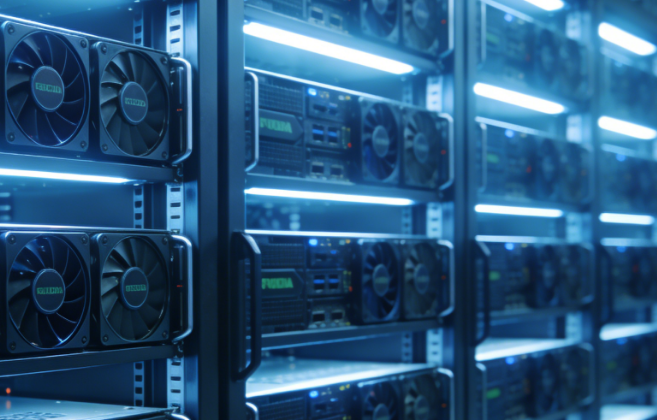
Faced with the increasingly saturated market and the strong global demand for artificial intelligence and cloud technology, Nvidia has continuously accelerated the pace of product R&D and iteration to consolidate its leading position in the market. It is understood that the group launched production of its latest generation of graphics processors, the "Rubin" series of graphics cards, in early January this year, just less than a year after the launch of the previous generation "Blackwell" products, representing a significant acceleration in R&D rhythm compared with the past. The "Rubin" architecture is named after astronomer Vera Rubin, equipped with a new Vera CPU, which can increase AI model training speed by 3.5 times compared with "Blackwell" and reduce inference costs by up to 10 times, boasting significant performance advantages[superscript:6].
In the news release, Jensen Huang clearly stated: "Demand for the computing power required to develop and deploy generative AI is growing exponentially." He further pointed out that "the turning point for AI agents has arrived"—referring to the emergence of AI agents capable of independently completing various tasks on demand. During a subsequent conference call, Jensen Huang added: "Because these 'agents working for you' operate continuously for minutes or even hours, they use processors far more frequently than when someone simply asks a question to ChatGPT." He noted that this demand has spawned a thousandfold increase in computing power requirements, which will drive sustained acceleration in investment across global information technology infrastructure, from chips to data centres.
Performance data shows that Nvidia's fourth-quarter sales reached $68.1 billion, a 73% increase year-on-year; its gross profit margin climbed sharply to 75%, a significant improvement from 73.4% in the previous quarter and 73% in the same period last year, reflecting the continuous enhancement of the core competitiveness of the company's products. Regarding future performance, Nvidia expects the current fiscal year's turnover to reach $78 billion, a year-on-year increase of approximately 77%. If this target is successfully achieved, it will further consolidate its leading position in the global chip industry.
Jacob, an analyst at Emarket Research, commented: "Nvidia has once again exceeded market expectations, and demand for the company's chips remains strong as major AI and cloud computing giants have committed substantial investment." He also pointed out that these tech giants are gradually expanding their supplier base, increasingly choosing companies that compete with Nvidia as partners. Meanwhile, Nvidia is actively promoting business diversification, attempting to expand its layout to more areas beyond data centres.
Currently, Nvidia's market capitalisation remains among the top in the global stock market, reaching $4.761 trillion, although it is still some distance from the all-time high set at the end of October last year. After the earnings report was released, Nvidia's stock price fell nearly 1% in after-hours electronic trading following a brief rise, reflecting the market's cautious attitude towards its future development.
Matt Britzman, an analyst at Hargreaves Lansdown, stated that there are still many questions about whether the wave of large-scale spending in the AI sector can continue in the coming years and beyond. However, he added that current analyst forecasts for Nvidia's turnover in 2026 and 2027 are clearly too low, and a series of upward revisions are expected following the release of this quarter's earnings data.
Regarding the Chinese market, Nvidia clearly stated that it does not expect to derive relevant gains from this market. Although the US government has granted licenses for the export of some of its non-high-end products to China, according to relevant media reports, the conditions set out in the licenses have increased the difficulty of exports. Based on the consideration of promoting the development of its own related industries, the Chinese authorities only allow a small amount of such goods to enter the Chinese market. It is understood that after the US government approved the export of Nvidia's H200 chips to China, due to relevant approval procedures and conditional restrictions, there has been no substantial progress in the sales of this product to China.