Heathrow Airport’s Third Runway Sparks Controversy Over Sky-High Costs, Reaching Up to £5 Million Per Metre
Recently, a new research report obtained by The Daily Telegraph shows that the construction cost of the third runway at London Heathrow Airport in the UK far exceeds expectations, with a cost of nearly £1 million per metre, and its exorbitant cost has triggered a fierce dispute between airlines and the airport operator. It is reported that the planning of Heathrow Airport’s third runway has been in the works for more than 20 years. As the core project of the airport’s £49 billion overall expansion plan, it is expected to be put into use no later than 2035, with all construction funds to be privately funded, without using a single penny of taxpayers’ money.
The research report was issued by Oxford Global Projects. Its estimation shows that the construction cost of the runway itself alone (including cement, asphalt and lighting facilities) will reach £830,000 per metre, making it one of the most expensive runways ever built in the world. The report clearly points out that this cost is "many times higher than the runway costs of other major airports", while the cost per metre of runways at most major airports around the world is only between £10,000 and £100,000. It is worth noting that this price estimation by Oxford Global Projects only targets the 2.2-mile-long runway itself and does not include the cost of other supporting facilities.
If various supporting projects are taken into account, the unit cost of the runway will rise further. The report shows that if earthworks (used to build a solid construction foundation) are included, the cost per metre will rise to £2 million; if all supporting facilities such as additional aprons, expanded airport apron areas and related equipment are covered, the cost per metre will reach as high as £5 million. In addition, this cost estimation does not include the cost of diverting the M25 motorway into a tunnel to ensure that the new runway can pass through it, and the diversion project itself will cost about £1.5 billion, further pushing up the overall expansion cost.
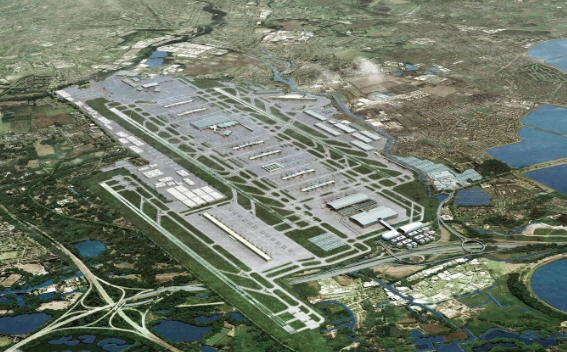
In addition to the runway, Oxford Global Projects also pointed out that the construction costs of Heathrow Airport’s infrastructure such as terminals, aircraft gates, baggage handling systems and parking lots are mostly among the top 10% of airports worldwide. The company said the research revealed a clear pattern of cost escalation at Heathrow, whether comparing its baggage handling systems with other airports in London or its flagship terminals with similar facilities around the world, even when considering other factors such as geographical location, the current situation of high costs is still very prominent. To ensure the objectivity of the research, Oxford Global Projects comprehensively compared Heathrow’s costs with the construction costs of 52 other terminals, 15 runways, 21 parking lots and 8 baggage handling systems around the world.
It is reported that this research was commissioned by the "Heathrow New Vision" organization, which was jointly established by several airlines including British Airways and Virgin Atlantic Airways. Its core goal is to reduce Heathrow Airport’s charges and cut the runway construction cost by up to £33 billion. At the same time, the "Heathrow Reimagined" organization composed of these airlines is also launching related activities to promote cost control.
Alexander Budzier, who led the research, said the results show that Heathrow Airport’s capital project spending has exceeded a reasonable level, and as Europe’s busiest airport, the economies of scale and cost savings it should have achieved have not been realized. He analyzed that the airport management’s willingness to cut costs is insufficient, and the core reason is that it believes the construction costs can ultimately be passed on to airlines and end passengers in the form of landing fees. "Ambition in design alone cannot explain the persistence of Heathrow’s high costs; the reasons seem to be related to the overall characteristics of the project’s planning and implementation," Budzier added.
In response to this research conclusion, various parties have expressed their views. Holly Boyd-Boland of Virgin Group said the research provides clear and independent evidence that Heathrow Airport’s infrastructure costs have long been higher than those of similar airports around the world. Jonathan Sullivan of International Airlines Group (IAG) called on the UK government and the Civil Aviation Authority (CAA) to strictly limit Heathrow Airport’s charges, "just like the current charging standards, this is the only way to protect passengers from these economic risks." It is reported that the UK Civil Aviation Authority is formulating a new airport charging model and is expected to submit a relevant report by May this year. The authority has previously stated that the increase in Heathrow Airport’s costs may lead to its charges significantly exceeding the current standards of other airports.
Faced with doubts from all parties, Heathrow Airport responded. Thomas Woldbye, the airport’s chief executive, said last week that landing fees at the airport do need to be increased to convince investors to support the runway construction project, but he refuted the airlines’ claim that fares would rise by £60, saying the cost per passenger would only need to increase by £15. He added that if airlines are willing to lower their requirements for the attractiveness of the airport expansion, the expansion cost may be further reduced.
Heathrow Airport emphasized that it has a good track record of completing infrastructure projects on time and within budget, and will continue to cooperate with the government and airlines to reduce the cost of runway construction. The airport also pointed out that a study by KPMG has concluded that its operating costs are at the average level compared with other airports. "The data in this so-called ‘independent analysis’ simply does not reflect our plans. Heathrow’s expansion is a privately funded project that does not use a single penny of taxpayers’ money," an airport spokesperson said.
It is reported that Heathrow Airport currently has only two runways, which have been operating at full capacity for a long time. The completion of the third runway will greatly increase the airport’s capacity, with an expected addition of at least 30 new routes per day and an annual passenger throughput increasing from the current 84 million to a maximum of 150 million. At present, in addition to the cost controversy, the airport expansion also faces opposition from environmental protection, noise and other aspects, and the UK Department for Transport is reviewing two different expansion plans proposed by Heathrow Airport and Aurora Group, with the final decision yet to be determined.