India's Crude Oil Processing Volume Slightly Fell in January 2026, with Continuous Optimization of Energy Import Strategy
Reportedly, energy data from India in January 2026 shows that the daily crude oil processing volume of the country's refineries fell slightly month-on-month, while fuel consumption presented a trend of year-on-year growth and month-on-month decline.
At the same time, India is improving its energy security layout by optimizing the import structure and expanding cooperation channels, with significant long-term growth potential in oil demand.
Data shows that India's daily crude oil processing volume in January was 5.63 million barrels per day (equivalent to 23.81 million tons), a month-on-month decrease of 0.2% compared with 5.64 million barrels per day in December 2025.
This is another slight decline since last month, and the overall operation maintained a moderate fluctuation. In terms of fuel consumption, the consumption volume in the month reached 21.05 million tons, which, although down from 21.71 million tons in the previous month, increased by nearly 3% year-on-year compared with January 2025, highlighting the long-term growth momentum of domestic energy consumption.
As one of the world's major energy-consuming countries, India's crude oil dependence on imports exceeds 80%, with imports mainly from Russia, Iraq, Saudi Arabia, the United Arab Emirates and the United States.
To ensure energy security, India has implemented a diversified import strategy. While balancing discounted crude oil from Russia and supplies from the Middle East and the United States, it has continuously expanded the scope of import partners to reduce the risk of a single source.
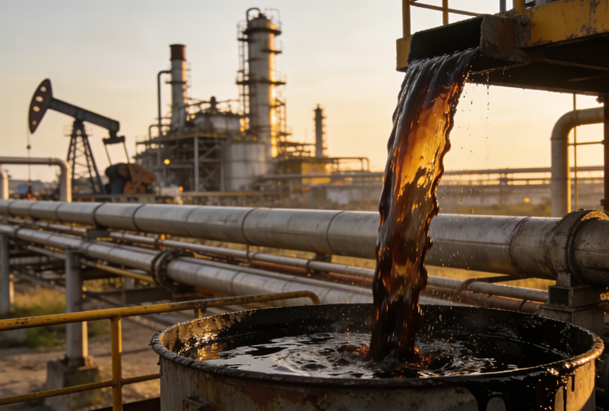
Recently, India has gradually adjusted its import structure, significantly increasing crude oil imports from Nigeria and Angola, and moderately reducing its dependence on Russian crude oil.
This adjustment is partly affected by political pressure and tariff threats from the United States. Meanwhile, the Trump administration has approved India to resume direct oil purchases from Venezuela, providing convenience for it to expand import channels.
It is reported that the Office of Foreign Assets Control (OFAC) of the U.S. Department of the Treasury has issued a general license to Reliance Industries, India's largest private refiner, allowing it to directly carry out the purchase, export and refining of oil from Venezuela.
This move came after U.S. troops captured former Venezuelan President Nicolas Maduro in January 2026, when Washington took control of Venezuela's oil sales. Venezuelan heavy crude oil is highly attractive to Indian refineries because of its low price and compatibility with complex refining facilities such as Reliance Industries' Jamnagar plant.
In the long run, India will become the core engine of global oil demand growth. Forecasts show that the country's oil demand will grow from about 5.6 million barrels per day in 2024 to more than 6.6 million barrels per day in 2030, and may reach 13.7 million barrels per day in 2050.
At that time, it will account for nearly half of the world's new oil production, and changes in its energy market will profoundly affect the global oil pattern.
Analysts point out that the current slight fluctuations in India's crude oil processing volume and fuel consumption are short-term adjustments. With the development of the domestic economy and urbanization, the long-term growth trend of energy demand is clear.
India's optimization of its crude oil import strategy is not only a flexible adjustment to cope with external pressure, but also a proactive measure to ensure energy security. Its future energy layout and demand changes deserve global attention.